| Posted: August 31, 2009 |
National Science Foundation awards $2 million to mimic nature's probes |
|
(Nanowerk News) The National Science Foundation has awarded Clemson University researchers $2 million to study ways to mimic the suction mechanism used by butterflies and moths to feed so that the same method can be used in medical diagnostics. The research will help develop a new class of fiber-based devices capable of probing and transporting previously impossible-to-reach liquids, such as those drawn from a single cell or tissue.
|
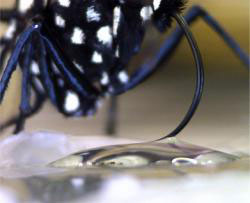 |
| The Monarch butterfly uses its proboscis to sip water from inside the drop. (Image: Daria Monaenkova, Clemson University)
|
|
“Right now, we have a real challenge of collecting fluids from miniscule places, such as a cell or a gland, without damaging them,” said principal investigator Konstantin Kornev, associate professor in the School of Materials Science and Engineering. “Butterflies and moths have an amazing system in that they can adapt their proboscis, which is their long feeding tube, to accommodate hard-to-reach places. It can also adjust to the difficult flow of both thin and thick liquids. We want to engineer that same ability, and we can learn a great deal from nature.”
|
|
Kornev said the goal is to develop probes for medical testing and that applications may some day include drawing DNA from a single cell. He adds that current “microfluidic devices,” the instruments that transport and analyze small amounts of liquids, are not flexible and are not able to deal with a wide range of liquids.
|
|
|
|
“The bio-inspired probes we envision are like an endoscope that is used to see inside the body. It would have many tiny hairs working like an octopus’ arms and grabbing many things at once. This way, we can map the tissue in question by picking and analyzing biofluids from different spots,” said Kornev. “In doing this, we’re taking advantage of recent progress in the field of fiber science and engineering.”
|
|
Co-investigators to the project are Peter Adler, professor of entomology, soil and plant science; Kenneth Christensen, assistant professor of genetics and biochemistry; Richard Groff, assistant professor in electrical and computer engineering; and Alexey Vertegel, assistant professor of bioengineering. The research is part of an ongoing project to develop fiber-based medical devices in Clemson’s School of Materials Science and Engineering and the Center for Advanced Engineering Fibers and Films.
|
