| Posted: September 1, 2009 |
New Southampton clean room to push the boundaries of technology |
|
(Nanowerk News) The University of Southampton’s Southampton Nanofabrication Centre, which opens next week (9 September), will make it possible to manufacture high-speed and non-volatile ‘universal memory’ devices for industry within 5 years.
|
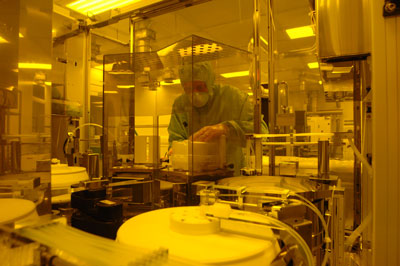 |
| New Mountbatten Building clean room, University of Southampton.
|
|
According to Dr Yoshishige Tsuchiya from the Nano Group at the University's School of Electronics & Computer Science, the Nano electromechanical systems (NEMS) available within the new clean room will make high-speed, non-volatile and low-power computer memory a reality.
|
|
'This high-speed, non-volatile and low-power NEMS memory will be suitable for pen drive devices for PCs and mobile applications and will mean that computers will warm up immediately when switched on and will have a ‘sleep’ switch to conserve energy,’ said Dr Tsuchiya. Working with Professor Hiroshi Mizuta in the Nano Group, Dr Tsuchiya will combine conventional silicon technology with the NEMS concept. ‘In the clean room, we will have both conventional equipment and new nanofabrication facilities such as Electron Beam Lithography and Focused Ion Beam, which we will use to fabricate the new memory devices,’ Dr Tsuchiya added.
|
|
The academics also plan to use the new equipment to do what they call “More than Moore” and “Beyond CMOS” (Complementary metal-oxide-semiconductor). The former involves integrating nanoelectromechanical Systems (NEMS) into conventional electronic devices to create advanced switch, memory and sensor devices, while the latter involves working on quantum information devices based on single-electron and single-spin device technology which could realize massively-parallel information processing.
|
|
|
|
‘I believe that if we adopt unique properties of well-controlled silicon nanostructures and co-integration with other emerging technologies such as NEMS, nanophotonics and nanospintronics, we can develop extremely functional information processing devices, faster than anything we could ever have imagined with just conventional technologies,’ Professor Mizuta said.
|
