| Posted: April 1, 2010 |
Exploring the frictional characteristics of atomically thin sheets |
|
(Nanowerk News) A team of nanotechnology researchers from the University of Pennsylvania and Columbia University has used friction force microscopy to determine the nanoscale frictional characteristics of four atomically-thin materials, discovering a universal characteristic for these very different materials. Friction across these thin sheets increases as the number of atomic layers decreases, all the way down to one layer of atoms.
|
|
This friction increase was surprising as there previously was no theory to predict this behavior. The finding reveals a significant principle for these materials, which are widely used as solid lubricant films in critical engineering applications and are leading contenders for future nanoscale electronics.
|
|
Researchers found that friction progressively increased as the number of layers is reduced on all four materials, regardless of how different the materials may behave chemically, electronically or in bulk quantities. These measurements, supported by computer modeling, suggest that the trend arises from the fact that the thinner a material the more flexible it is, just as a single sheet of paper is much easier to bend than a thick piece of cardboard.
|
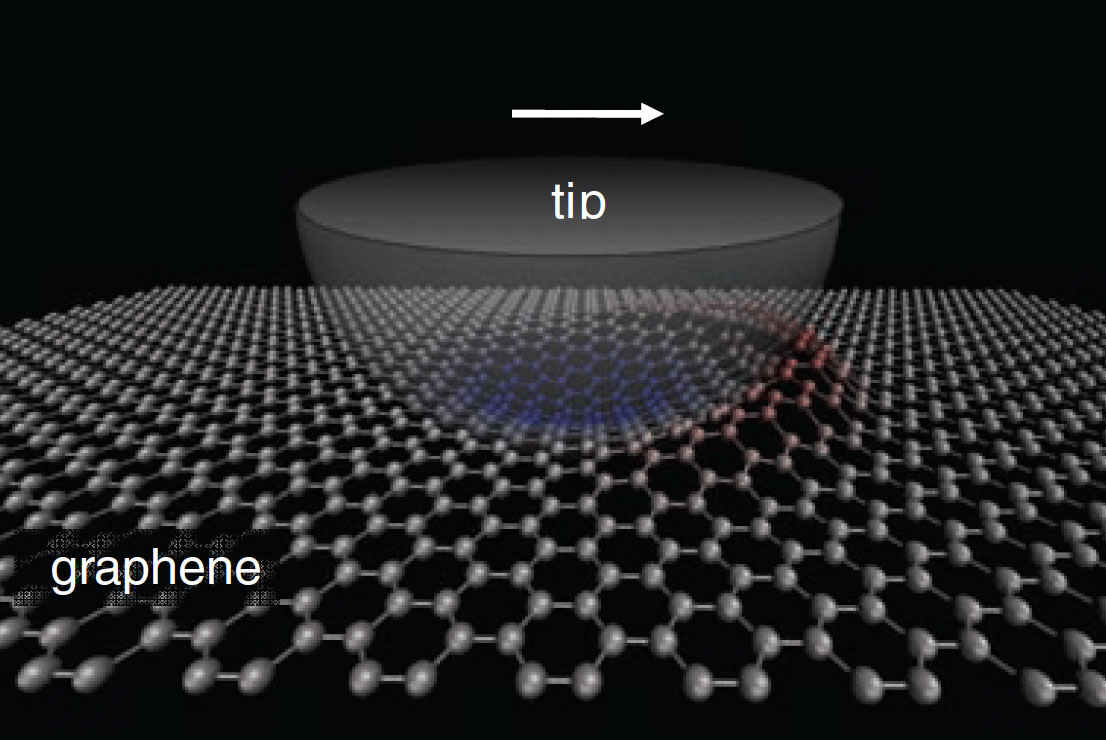 |
| Interatomic forces cause attraction between the atomic sheet and the nano-scale tip of the atomic force microscope. Thin sheets deflect toward the tip, therefore increasing friction. When the tip starts to slide, the sheet deforms further as the deformed area is partially pulled along with the tip. The color scale of the atoms indicates how far the atoms have moved upward (red) or downward (blue) from their original positions. Thicker sheets cannot deflect as easily because they are much stiffer, so the increase in friction is less pronounced, consistent with study measurements. (Image: University of Pennsylvania and Science)
|
|
Robert Carpick, professor in the Department of Mechanical Engineering and Applied Mechanics at Penn, and James Hone, professor in the Department of Mechanical Engineering at Columbia, led the project collaboratively.
|
|
The team tested the nanotribological, or nano-scale frictional properties, of graphene, molybdenum disulfide (MoS2), hexagonal-BN (h-BN) and niobium diselenide (NbSe2) down to single atomic sheets. The team literally shaved off atomic-scale amounts of each material onto a silicon oxide substrate and compared their findings to the bulk counterparts. Each material exhibited the same basic frictional behavior despite having electronic properties that vary from metallic to semiconducting to insulating.
|
|
"We call this mechanism, which leads to higher friction on thinner sheets the 'puckering effect,'" Carpick said. "Interatomic forces, like the van der Waals force, cause attraction between the atomic sheet and the nanoscale tip of the atomic force microscope which measures friction at the nanometer scale."
|
|
Because the sheet is so thin — in some samples only an atom thick — it deflects toward the tip, making a puckered shape and increasing the area of interaction between the tip and the sheet, which increases friction. When the tip starts to slide, the sheet deforms further as the deformed area is partially pulled along with the tip, rippling the front edge of the contact area. Thicker sheets cannot deflect as easily because they are much stiffer, so the increase in friction is less pronounced.
|
|
The researchers found that the increase in friction could be prevented if the atomic sheets were strongly bound to the substrate. If the materials were deposited onto the flat, high-energy surface of mica, a naturally occurring mineral, the effect goes away. Friction remains the same regardless of the number of layers because the sheets are strongly stuck down onto the mica, and no puckering can occur.
|
|
"Nanotechnology examines how materials behave differently as they shrink to the nanometer scale," Hone said. "On a fundamental level, it is exciting to find yet another property that fundamentally changes as a material gets smaller."
|
|
The results may also have practical implications for the design of nanomechanical devices that use graphene, which is one of the strongest materials known. It may also help researchers understand the macroscopic behavior of graphite, MoS2 and boron nitride, which are used as common lubricants to reduce friction and wear in machines and devices.
|
