| Posted: August 3, 2010 |
Faster DNA analysis at room temperature |
|
(Nanowerk News) DNA microarrays are one of the most powerful tools in molecular biology today. The devices, which can be used to probe biological samples and detect particular genes or genetic sequences, are employed in everything from forensic analysis to disease detection to drug development.
|
|
Now Paul Li and colleagues at Simon Fraser University in Burnaby, Canada have combined DNA microarrays with microfluidic devices, which are used for the precise control of liquids at the nanoscale. In an upcoming issue of the journal Biomicrofluidics, which is published by the American Institute of Physics (AIP), Li and his colleagues describe how the first combined device can be used for probing and detecting DNA.
|
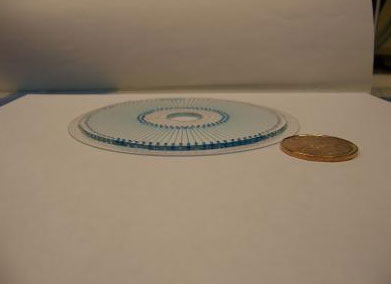 |
| A palm-sized biochip for room temperature DNA detection developed by Paul Li at Simon Fraser University near Vancouver, Canada. The 4" diameter chip is roughly the same thickness as the Canadian one dollar coin, the Loonie (shown in the picture for scale).
|
|
The key to Li's result: gold nanoparticles. Suspended in liquid and mixed with DNA, the nanometer-scale spheres of gold act as mini magnets that adhere to each of the DNA's twin strands. When the DNA is heated, the two strands separate, and the gold nanoparticles keep them apart, which allows the single strands to be probed with other pieces of DNA that are engineered to recognize particular sequences.
|
|
Li, whose work is funded by the Natural Sciences and Engineering Research Council of Canada, is applying for a patent for his technique. He sees a host of benefits from the combination of DNA microarrays and microfluidics.
|
|
"It's faster and requires a relatively small sample," he says, adding in his paper that "the whole procedure is accomplished at room temperature in an hour and apparatus for high temperature… is not required"
|
