| Posted: September 3, 2010 |
Zinc oxide snowflakes |
|
(Nanowerk News) Modelling zinc oxide nanoparticle formation could provide new insights into how snowflakes form as well as aiding nanoscale device research, say Chinese scientists.
|
|
Snowflakes are formed in the atmosphere via complicated crystallisation and melting processes. What exactly happens is one of the great mysteries of nature but despite unwavering interest, the formation mechanism remains unknown. In addition to being a curiosity, this knowledge could have important scientific and technological relevance by providing insights into crystal growth dynamics and pattern formation during solidification. This could help in nanoscale device self-assembly.
|
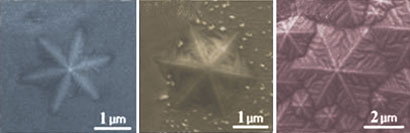 |
| Different patterns are fomed depending on the coverage of the surface.
|
|
Hong-Jun Gao and his team at the Chinese Academy of Sciences in Beijing have found that when synthesising ZnO nanoparticles under appropriate conditions, symmetric patterns resembling snowflakes are formed on the surface. 'It is a fortuitous discovery to some extent,' says Gao.
|
|
Gao's team used Monte Carlo simulations to probe the nanoparticle formation mechanism, which, they think has parallels with snowflake formation. The pattern formed depends on the nanoparticle surface coverage, says Gao. When coverage is low, the main snowflake branches grow quicker than the side branches owing to the screening effect that prevents aggregation of particles between the main branches and leads to star-like patterns. When coverage is high, the side branches grow quicker, producing leaf-like patterns.
|
|
'Our observations broaden the morphology phase space reachable with Zn and O as the building blocks,' explains Gao, emphasising the works fundamental significance.
|
|
'I was impressed by the attempt made to offer a theoretical model for what they think is going on,' says Mark Andrew, an expert in materials chemistry at McGill University in Montreal, Canada. 'This is a pleasant development, when the research goes beyond suggestive imitation and actually tries to build bridges to important research like that of snowflake patterning.'
|
|
Having explored how these materials relate to nature, the team now plan to look at how these materials might be used in electronic applications.
|
