| Sep 06, 2011 |
Microbes generate electricity with nanowires while cleaning up nuclear waste
|
|
(Nanowerk News) Researchers at Michigan State University have unraveled the mystery of how microbes generate electricity while cleaning up nuclear waste and other toxic metals.
|
|
Details of the process, which can be improved and patented, are published in the current issue of the Proceedings of the National Academy of Sciences ("Extracellular reduction of uranium via Geobacters conductive pili as a protective cellular mechanism"). The implications could eventually benefit sites forever changed by nuclear contamination, said Gemma Reguera, MSU microbiologist.
|
|
"Geobacters bacteria are tiny micro-organisms that can play a major role in cleaning up polluted sites around the world," said Reguera, who is an MSU AgBioResearch scientist. "Uranium contamination can be produced at any step in the production of nuclear fuel, and this process safely prevents its mobility and the hazard for exposure."
|
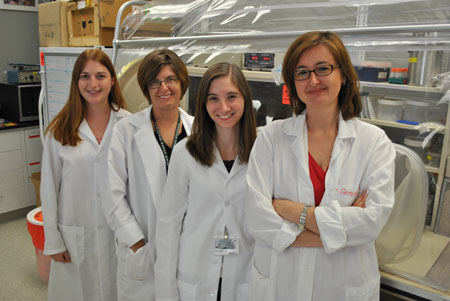 |
| MSU microbiologist Gemma Reguera (right) and her team of researchers have unraveled the mystery of how microbes generate electricity while cleaning up nuclear waste.
|
|
The ability of Geobacters to immobilize uranium has been well documented. However, identifying the Geobacterss' conductive pili or nanowires as doing the yeoman's share of the work is a new revelation. Nanowires, hair-like appendages found on the outside of Geobacters, are the managers of electrical activity during a cleanup.
|
|
"Our findings clearly identify nanowires as being the primary catalyst for uranium reduction," Reguera said. "They are essentially performing nature's version of electroplating with uranium, effectively immobilizing the radioactive material and preventing it from leaching into groundwater."
|
|
The nanowires also shield Geobacters and allow the bacteria to thrive in a toxic environment, she added.
|
|
Their effectiveness was proven during a cleanup in a uranium mill tailings site in Rifle, Colo. Researchers injected acetate into contaminated groundwater. Since this is Geobacterss' preferred food, it stimulated the growth of the Geobacters community already in the soil, which in turn, worked to remove the uranium, Reguera said.
|
|
Reguera and her team of researchers were able to genetically engineer a Geobacters strain with enhanced nanowire production. The modified version improved the efficiency of the bacteria's ability to immobilize uranium proportionally to the number of nanowires while subsequently improving its viability as a catalytic cell.
|
|
Reguera has filed patents to build on her research, which could lead to the development of microbial fuel cells capable of generating electricity while cleaning up after environmental disasters.
|
|
The research team included Dena Cologgi and Allison Speers, MSU graduate students, and Sanela Lampa-Pastirk and Shelly Kelly, post-doctoral researchers. The National Institute of Environmental Health Science and the U.S. Department of Energy funded the study.
|
