| Mar 06, 2006 |
First optically controlled basic device structure for quantum computers
|
|
(Nanowerk News) The National Institute of Advanced Industrial Science and Technology (AIST) in Japan has successfully developed the world’s first basic device structure extendable to multi-quantum-bits for an optically controlled quantum logic gate. This achievement is part of the "Core Research For Evolutional Science and Technology (CREST) project of the Japan Science and Technology Agency (JST).
|
|
Quantum computers are expected to be able to process huge amounts of information so that they can rapidly solve problems that take even supercomputers a long time. Because of this, organizations in many countries have been working on their development. Basic devices for quantum computers must have a structure enabling small size and multi-bit integration.
|
|
Recently, many studies on quantum bits (qubits) and quantum logic gates using solid-state materials such as superconductors and semiconductors have been reported. For devices utilizing excitons (electron-hole pairs) in semiconductors, optically-controlled ultra-high speed processing (a computing step of pico-seconds) is possible. However, there have been no reports on basic device structures which enable both "multi-bit" and strong "interaction between the two qubits," which are essential for quantum logic gates. Thus, recent work has focused on developing such quantum logic gates.
|
|
In this study, the researchers prepared coupled quantum dots, which are formed by closely arranging 2 or more quantum dots. By utilizing excitons confined in the respective dots as the qubit, they were able to create multi-bit structures. Furthermore, they have designed a unique structure which can induce strong interactions between the two qubits by adequately adjusting the distance between the dots.
|
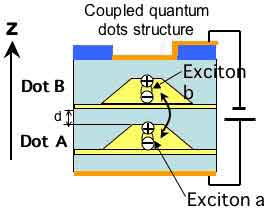 |
Schematic diagram of a 2-qubit logic gate using two excitons in coupled quantum dots. (Source: AIST)
|
|
Also in this study, using the MBE technique, the researchers fabricated a very small dot structure coupled in the direction of stacking, and developed a technique which can optically control and detect two separate excitons in the coupled dots. Furthermore, using these techniques, they have successfully developed the world’s first optically controlled 2-qubit logic gate structure capable of having multi-qubits and strong interactions between the two qubits.
The results of this study titled "Observation of exciton molecule consisting of two different excitons in coupled quantum dots" were published in the Dec. 19, 2005 issue of Applied Physics Letters.
|
