| Posted: August 6, 2008 |
World's thinnest balloon made of graphene |
|
(Nanowerk News) Researchers in New York are reporting development of the world's thinnest balloon, made of a single layer of graphite just one atom thick. This so-called graphene sealed microchamber is impermeable to even the tiniest airborne molecules, including helium. It has a range of applications in sensors, filters, and imaging of materials at the atomic level, they say in a study scheduled for the August 13 issue of ACS' Nano Letters ("Impermeable Atomic Membranes from Graphene Sheets").
|
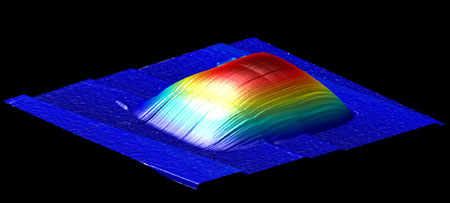 |
| A multi-layer graphene membrane that could be used in various applications, including filters and sensors (Image: Jonathan Alden)
|
|
Paul L. McEuen and colleagues note that membranes are fundamental components of a wide variety of physical, chemical and biological systems, found in everything from cellular compartments to mechanical pressure sensing. Graphene, a single layer of graphite, is the upper limit: A chemically stable and electrically conducting membrane just one atom thick. The researchers wanted to answer whether such an atomic membrane would be impermeable to gas molecules and easily incorporated into other devices.
|
|
Their data showed that graphene membranes were impermeable to even the smallest gas molecules. These results show that single atomic sheets can be integrated with microfabricated structures to create a new class of atomic scale membrane-based devices. We envision many applications for these graphene sealed microchambers, says McEuen. These range from hyper-sensitive pressure, light and chemical sensors to filters able to produce ultrapure solutions.
|
