| Posted: September 10, 2008 |
Flower-shaped nanoparticles may lead to better batteries for portable electronics |
|
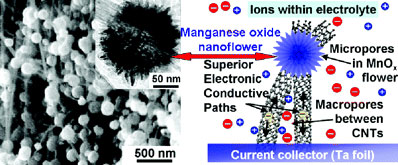
(Nanowerk News) Want more power and longer battery life for that cell phone, laptop, and digital music player? “Flower power" may be the solution. Chemists are reporting development of flower-shaped nanoparticles with superior electronic performance than conventional battery materials. These “nanoflowers” may power next-generation electronic devices, say the scientists in a report scheduled for the Oct. 8 issue of ACS’ Nano Letters ("Flower-shaped nanoparticles may lead to better batteries for portable electronics").
|
 |
|
Gaoping Cao and colleagues point out that nanoflowers are not new. Researchers have developed various types of flower-shaped nanoparticles using different materials, including manganese oxide, the key metallic ingredient that powers conventional batteries. However, older-generation nanoflowers were not suitable for electronic products of the future, which will demand more power and longer battery life, the researchers say.
|
|
In the new study, scientists first grew clusters of carbon nanotubes, strands of pure carbon 50,000 times thinner than a human hair, that are known to have superior electrical conductivity. The scientists then deposited manganese oxide onto the nanotubes using a simple, low-cost coating technique called “electrodeposition,” resulting in nano-sized clusters that resemble tiny dandelions under an electron microscope. The result was a battery system with higher energy storage capacity, longer life, and greater efficiency than conventional battery materials, the researchers say.
|
