
| Posted: Nov 13, 2006 | |
Military nanotechnology - how worried should we be? |
|
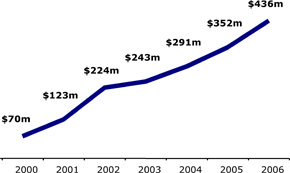
| (Nanowerk Spotlight) All major powers are making efforts to research and develop nanotechnology- based materials and systems for military use. Asian and European countries, with the exception of Sweden (Swedish Defence Nanotechnology Programme), do not run dedicated programs for defense nanotechnology research. Rather, they integrate several nanotechnology-related projects within their traditional defense-research structures, e.g., as materials research, electronic devices research, or bio-chemical protection research. Not so the U.S. military. Stressing continued technological superiority as its main strategic advantage, it is determined to exploit nanotechnology for future military use and it certainly wants to be No. 1 in this area. The U.S. Department of Defense (DoD) is a major investor, spending well over 30% of all federal investment dollars in nanotechnology. Of the $352m spent on nanotech by the DoD in 2005, $1m, or roughly 0.25%, went into research dealing with potential health and environmental risks. In 2006, estimated DoD nanotechnology expenditures will be $436m – but the risk-related research stays at $1m. | |
 |
|
| Annual DoD investment in nanotechnology; 2006 estimated. (Source data: DoD "Defense Nanotechnology Research and Development Programs", May 8, 2006) | |
| Proposed and actively pursued military nanotech programs cover a wide range of applications to improve the performance of existing systems and materials and allow new ones. The main areas of research deal with explosives (their chemical composition as well as their containment); bio and medicine (for both injury treatment and performance enhancement); biological and chemical sensors; electronics for computing and information; power generation and storage; structural materials for ground, air and naval vehicles; coatings; filters; and fabrics. | |
| Structure of the DoD Nanotechnology Program | |
| In the mid-1990s the DoD identified nanotechnology as one of six “Strategic Research Areas” (the other five being bioengineering sciences, human performance sciences, information dominance, multifunction materials, propulsion and energetic sciences). The DoD nanotechnology program is grouped into seven program component areas (PCAs), which mirror the PCAs of the U.S. National Nanotechnology Initiative (NNI): | |
| |
| About half of the DoD’s nanotech investment goes to DARPA (Defense Advanced Research Projects Agency), with the rest roughly evenly split between Army, Navy and Air Force. Besides DARPA, the major agencies leading the effort are the Naval Research Laboratory (NRL), the Army Research Laboratory (ARL), the Air Force Office of Scientific Research (AFOSR), and MIT's Institute for Soldier Nanotechnologies (ISN). In addition, the DoD established a Defense University Research Initiative on NanoTechnology (DURINT). The DURINT program is intended to enhance U.S. universities’ capabilities to perform basic science and engineering research and related education in nanotechnology critical to national defense. | |
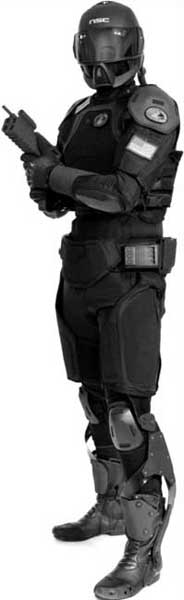 Future Warrior, a visionary concept of how the Soldier of 2025 might be equipped.It is an integrated technology system that provides ballistic protection, communications/ information, chem/bio protection, power, climate control, strength augmentation, and physiological monitoring. Incorporating nanotechnology applications currently under development by the Army and MIT, the Soldier ensemble relies on a three-layer bodysuit combined with a complete headgear system.(Source: MIT's Institute for Soldier Nanotechnologies) Most of the DoD dollars spent to date have gone into basic research and engineering. Insofar as these engineering and materials aspects of military nanotechnology incorporate engineered nanomaterials, there are near-term issues that need to be discussed and resolved: the potential toxicity of such materials (which applies to all engineered nanomaterials, not just those for military use), their impact on humans and the environment, and if and how release of such nanomaterials into the environment through military use could exceed release from non-military uses. While very active in developing nanotech applications, the military is much more passive in assessing the risks and is content to monitor what other agencies do. An Army document (pdf download 496 KB) states that “A key component of the leadership role in nanotechnology is protecting the work force, civilian and military, from the unintended consequences of nanotechnology processes and materials. The Army should take an active role in drafting environmental, safety, and occupational health guidelines for nanomaterials to ensure contractors follow best environmental practices in the development, manufacture, and application of the new technology.” However, this “active role” appears not yet to have materialized. A spokesman for the U.S. Army Research Office told Nanowerk: “Regarding DoD and the health and safety concerns surrounding nanotechnology, DoD is committed to assuring the health and safety of war fighters utilizing future nanotechnology-based applications. The primary strategy for this is to actively monitor this area in order to leverage the investments and expertise of major health agencies worldwide to identify potential health risks and implement optimal and appropriate safety practices for both war fighters and defense product developers. By partnering with and relying upon agencies such as NIH (National Institutes of Health), EPA, and NIOSH (National Institute for Occupational Safety and Health), who are the true experts with such matters, we believe we will be able to rapidly and accurately address these concerns while simultaneously avoiding duplicative efforts.” Military Nanotech Risk Factors Go Beyond Civilian Risk Some of the military-motivated research could clearly have a positive impact on everyday life (e.g., more powerful batteries, bio and chemical sensors to detect pollutants, filters to remove nanoscale pollutants and toxins, smart fabrics). Others not only pose the same potential risk that commercially used engineered nanomaterials do, for instance during production, but, due to their intended area of use, could have a greater chance of reaching and affecting the environment. Two examples: |
|
| Of considerable concern is the question to what degree military nanotech could lead to destabilization (when one military power develops a technology that others cannot effectively defend against) and undermine arms-control agreements like the Biological Weapons Convention. A NATO study group states that “the potential for nanotech-driven innovations in chemical and biological weapons are particularly disquieting as they can considerably enhance the delivery mechanisms of agents or toxic substances. The ability of nanoparticles to penetrate the human body and its cells could make biological and chemical warfare much more feasible, easier to manage and to direct against specific groups or individuals.” | |
| Other, longer-term risk factors arise from hotly debated concepts dealing with molecular assembly and self-replicating nanomachinery or from societal issues such as the potential destabilization posed by military nanotechnology applications (e.g., What will be the impact of omnipresent sensor nets and autonomous fighting systems? What are the ethical implications of non-medical implants in soldiers?). | |
| Some examples | |
| Here are current and near-term (from today until 2010) projects that will incorporate “free” engineered nanoparticles, i.e., where at some stage in production or use individual nanoparticles of a substance are present (compiled from public information on various DoD websites): | |
|
|
|
| This list is far from exhaustive. More visionary applications and materials such as performance- enhancing nanoengineered protheses and bio-engineered weapons are conceptually feasible but are unlikely to see realization within the next 10-15 years. | |
 By
Michael
Berger
– Michael is author of three books by the Royal Society of Chemistry:
Nano-Society: Pushing the Boundaries of Technology,
Nanotechnology: The Future is Tiny, and
Nanoengineering: The Skills and Tools Making Technology Invisible
Copyright ©
Nanowerk LLC
By
Michael
Berger
– Michael is author of three books by the Royal Society of Chemistry:
Nano-Society: Pushing the Boundaries of Technology,
Nanotechnology: The Future is Tiny, and
Nanoengineering: The Skills and Tools Making Technology Invisible
Copyright ©
Nanowerk LLC
|
Become a Spotlight guest author! Join our large and growing group of guest contributors. Have you just published a scientific paper or have other exciting developments to share with the nanotechnology community? Here is how to publish on nanowerk.com.