| Posted: May 07, 2009 | |
Nanotechnology breath analyzer for kidney failure |
|
| (Nanowerk Spotlight) High blood pressure and diabetes, increasingly common signs of the unhealthy lifestyle in most Western societies, often are the cause for chronic kidney disease (or chronic renal disease; CKD). CKD is a long-standing, progressive deterioration of renal function. In its end-stage, the disease is a debilitating medical condition of chronic kidney failure which requires intensive and costly treatments through dialysis or even transplantation. Initially, as renal tissue loses function, there are few abnormalities because the remaining tissue increases its performance. | |
| Diagnosis of CKD is mostly based on laboratory testing of renal function such as plasma levels of creatinine and urea, sometimes followed by renal biopsy. Imaging techniques are also applied to detect changes in size, texture, and position of the kidneys. These measurements are performed using ultrasound and are suitable only in patients suffering from progressive renal failure. Presently, renal biopsy remains the most definitive test to specifically diagnose chronic and acute renal failure. This method is invasive and thus comprises the risk of infections and bleeding among other possible complications. | |
| "So far, blood tests and urinalysis are the golden standard to identify a decline in kidney filtration, wherein high levels of creatinine and blood urea nitrogen usually reflect renal dysfunction – however, these tests tend to be highly inaccurate and may remain within the normal range even while 65-75% of kidney function is lost." Hossam Haick, senior lecturer in the Faculty of Chemical Engineering and the Russell Berrie Nanotechnology Institute at Technion-Israel Institute of Technology, tells Nanowerk. "Given the difficulties in separating healthy renal function from dysfunction, it is perhaps not too surprising that precise biochemical or clinical criteria for diagnosis of acute renal failure have been elusive. Therefore, there is an unmet need for a noninvasive method for detection of renal failure of various etiologies. Furthermore, the challenge remains to diagnose renal disorders with sufficient sensitivity and specificity to provide a large-scale screening technique, feasible for clinical practice, for people at increased risk of developing renal dysfunction." | |
| Haick, Zaid Abassi and coworkers from Technion used an experimental model of end stage renal disease (ESRD) in rats to identify by advanced, yet simple nanotechnology-based approach to discriminate between exhaled breath of healthy states and of ESRD states. The team reported their findings in the April 27, 2009 online edition of ACS Nano ("Sniffing Chronic Renal Failure in Rat Model by an Array of Random Networks of Single-Walled Carbon Nanotubes"). | |
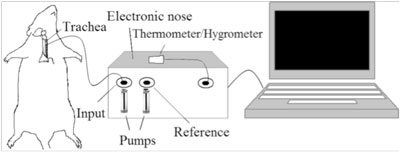
| In their work, Haick and his team used gas chromatography/ mass spectroscopy in conjugation with solid phase microextraction of healthy and ESRD breath, collected directly from the trachea of the rats, to identify 15 common volatile organic compounds (VOCs) in all samples of healthy and ESRD states and 27 VOCs that appear in diseased rats but not in healthy states. | |
 |
|
| Schematic illustration of the experimental system used to collect breath normal rats and animals that underwent bilateral nephrectomy (Reprinted with permission from ACS Publications). | |
| Online breath analysis via an array of chemiresistive random network of single walled carbon nanotubes (SWCNTs) coated with organic materials showed excellent discrimination between the various breath states. Furthermore, the analysis shows the adequacy of using representative simulated VOCs to imitate the breath of healthy and ESRD states and, therefore, to train the sensors’ array the pertinent breath signatures. | |
| "Using SWCNT networks circumvents the requirement of position and structural control (as is the case in devices based on individual SWCNT) because the devices display the averaged usual properties of many randomly distributed SWCNTs," says Haick. "An additional feature of SWCNT networks is that they can be processed into devices of arbitrary size using conventional microfabrication technology." | |
| An important implication of these findings, besides the detection of diseases directly related to the respiratory, cardiovascular, and renal systems, is the fact that VOCs are mainly blood borne and the concentration of biologically relevant substances in exhaled breath closely reflects that in the arterial system. Therefore, breath is predestined for monitoring different processes in the body. | |
| Apart from the odor impression of chronic kidney failure, much about the biochemical processes and the formation of marker substances is already known. Haick notes that analysis of the various breath samples by an array of chemiresistive random network of SWCNTs showed excellent discrimination between the various breath states, while revealing significantly enhanced discriminations at lower humidity levels in the breath. | |
| "Furthermore, we show that it is enough to use selected number of simulated VOCs to 'train' the sensors’ array system to discriminate between the electronic patterns of healthy states and chronic failure states," says Haick. "Experiments to distinguish less severe kidney failure (e.g., 35-70% reduction in kidney function) and to distinguish chronic kidney failure from other disease (or patho-physiological) states that have a potential to produce a distorted profile of breath VOCs (e.g., liver failure, systemic infection, pneumonia, heart failure, etc.) are underway and will be published soon." | |
| The excellent discrimination between the various breath states obtained in this study provides expectations for future capabilities for diagnosis, detection, and screening various stages of kidney disease, especially in the early stages of the disease, where it is possible to control blood pressure, fat, glucose and protein intake to slow the progression. | |
| In terms of the devices, the challenges could be summarized in how to bring the sensing technology to a level that it will be very simple to use, lightweight, low-power, and able to detect diseases in noninvasive way (i.e., via breath samples) in real time. | |
 By
Michael
Berger
– Michael is author of three books by the Royal Society of Chemistry:
Nano-Society: Pushing the Boundaries of Technology,
Nanotechnology: The Future is Tiny, and
Nanoengineering: The Skills and Tools Making Technology Invisible
Copyright ©
Nanowerk LLC
By
Michael
Berger
– Michael is author of three books by the Royal Society of Chemistry:
Nano-Society: Pushing the Boundaries of Technology,
Nanotechnology: The Future is Tiny, and
Nanoengineering: The Skills and Tools Making Technology Invisible
Copyright ©
Nanowerk LLC
|
|
|
Become a Spotlight guest author! Join our large and growing group of guest contributors. Have you just published a scientific paper or have other exciting developments to share with the nanotechnology community? Here is how to publish on nanowerk.com. |
|
