
| Posted: Nov 22, 2006 | |
Carbon nanotubes could make t-shirts bullet proof |
|
| (Nanowerk Spotlight) Carbon nanotubes (CNTs) have great potential applications in making ballistic-resistance materials. The remarkable properties of CNTs makes them an ideal candidate for reinforcing polymers and other materials, and could lead to applications such as bullet-proof vests as light as a T-shirt, shields, and explosion-proof blankets. For these applications, thinner, lighter, and flexible materials with superior dynamic mechanical properties are required. | |
| A study by researchers in Australia explores the energy absorption capacity of a single-walled carbon nanotube under a ballistic impact. The result offers a useful guideline for using CNTs as a reinforcing phase of materials to make devices to prevent from ballistic penetration or high speed impact. | |
| Professor Liangchi Zhang from the School of Aerospace, Mechanical and Mechatronic Engineering at the University of Sydney explained the new research to Nanowerk: " Especially in making bullet-proof vests, shields, and explosion proof blankets, the best protective material will have a high level of elastic storage energy that will cause the projectile to bounce off or be deflected, i.e., the objective is to reduce the effects of 'blunt trauma' on the wearer after being struck by a bullet. We therefore tried to understand the impact behavior of CNTs." | |
| Zhang published his recent findings, titled "Energy absorption capacity of carbon nanotubes under ballistic impact", in the September 18, 2006 issue of Applied Physics Letters. | |
| Zhang's study analyzes the impact of a bullet on nanotubes of different radii in two extreme cases. For a nanotube with one end fixed, the maximum nanotube enduring bullet speed increases and the energy absorption efficiency decreases with the increase in relative heights at which the bullet strikes; these values are independent of the nanotube radii when the bullet hits at a particular relative height. For a nanotube with both ends fixed, the energy absorption efficiency reaches minimum when the bullet strikes around a relative height of 0.5. | |
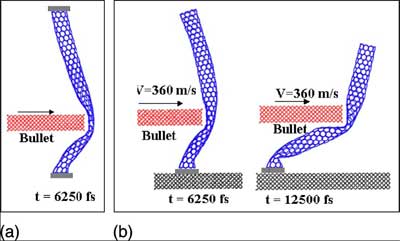 |
Bullet strikes the nanotube at a relative height of 0.31 (a) with both ends fixed and (b) with one end fixed. (Reprinted with permission from the American Institute of Physics) |
| "Specifically, we investigated the relationship between the nanotube radius, the relative position at which the bullet strikes, the bullet speed, and the energy absorbed by the nanotube for a particular bullet size and shape" says Zhang. | |
| A piece of diamond having 1903 atoms was used as a bullet with its speed varying from 100 to 1500 m/s. The bullet dimension was selected such that the width is larger than the width of the biggest nanotube after flattening. The bullet was released from a target about 15 Â from the center axis of the nanotube and moved at a constant speed in the horizontal direction i.e., perpendicular to the nanotube axis, as shown in the graphic above. The nanotube performance was examined for bullet released with various speeds at various positions using the classical molecular dynamics method. | |
| In his experiments, Zhang found that, for a nanotube with one end fixed, the CNT could be resilient to projectile traveling at speeds of 200–1400 m/s (for comparison, the initial velocity of modern rifle bullets is somewhere between 180 and 1500 m/s, depending on gun and bullet type. For a typical over-the-counter gun the speed is below 1000 m/s); the nanotube enduring projectile speed increases whereas the absorption efficiency decreases with the increase in relative height ρ. For a nanotube with both ends fixed, the absorption energy reaches maximum whereas the absorption efficiency reaches minimum when the bullet strikes the nanotube in the middle. | |
| Zhang is excited by the great potential offered by CNTs in making ballistic-resistance materials and his research in this area is ongoing: "We'll continue to try to understand the impact behavior of CNTs under more complicated loading conditions." | |
| There is a more recent follow-up Spotlight on this work at Bullets harmlessly bouncing off nanotechnology T-shirts. | |
 By
Michael
Berger
– Michael is author of three books by the Royal Society of Chemistry:
Nano-Society: Pushing the Boundaries of Technology,
Nanotechnology: The Future is Tiny, and
Nanoengineering: The Skills and Tools Making Technology Invisible
Copyright ©
Nanowerk LLC
By
Michael
Berger
– Michael is author of three books by the Royal Society of Chemistry:
Nano-Society: Pushing the Boundaries of Technology,
Nanotechnology: The Future is Tiny, and
Nanoengineering: The Skills and Tools Making Technology Invisible
Copyright ©
Nanowerk LLC
|
Become a Spotlight guest author! Join our large and growing group of guest contributors. Have you just published a scientific paper or have other exciting developments to share with the nanotechnology community? Here is how to publish on nanowerk.com.