| Posted: Jan 08, 2010 | |
Highly effective single-protein nanocapsules improve prospects for protein therapies |
|
| (Nanowerk Spotlight) Proteins are the most important molecules inside our body. There are thousands of proteins in a single cell alone and they control our physiological reactions, metabolism, cellular information flow, defense mechanisms – pretty much everything. No wonder then that most human diseases are related to the malfunctioning of particular proteins. | |
| In contrast to gene therapy – where a gene is placed inside a cell to either replace a defective gene or to increase the amount of a specific gene in order to produce a higher amount of a desired protein – protein therapy works by directly delivering well-defined and precisely structured proteins into the cell to replace the dysfunctional protein. This approach avoids the difficulties and potential problems of gene therapy and is generally considered the most direct and safe approach for treating disease. | |
| The problem with protein therapy, which limits its practical use in medicine, is the mode of delivery. Administration of proteins via oral, intravenous, intra-arterial, or intramuscular routes show low delivery efficiency and often the therapeutic protein is metabolized or cleared before it can enter the target tissue. | |
| A team of scientists at UCLA has now demonstrated a general, effective, low-toxicity intracellular protein delivery system based on single-protein nanocapsules. This work opens a new direction not only for protein therapy but also for cellular imaging, tumor tracking, cosmetics and many other applications. | |
| "Current protein therapy approaches encapsulate several proteins into larger nanoparticles or conjugate polymers to the proteins to increase stability and endocytosis rate" Tatiana Segura, an assistant professor in UCLA's Department of Chemical and Biomolecular Engineering, explains to Nanowerk. "We wanted to come up with a more efficient technology to deliver proteins. Our novel delivery platform is novel because we are only including a single protein and a thin polymeric shell around it. The particles are less than 20 nm in diameter, depending on the size of the protein core." | |
 |
|
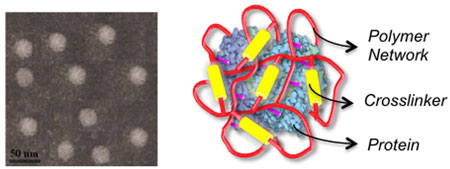
| (Left) Transmission electronic microscopic (TEM) image of single-protein nanocapsules with uniform size distribution (∼30 nm in diameter) and (right) a schematic of the nanocapsule consisting of an encased protein and a skin layer of crosslinked polymer network. (Images: Professor Yunfeng Lu, UCLA) | |
| The nanocapsules consist of a single-protein core and thin polymer shell anchored covalently to the protein core. Depending on whether degradable or non-degradable crosslinkers are used in synthesizing the nanocapsule, the skin of the capsule is either degradable or non-degradable. This is an important feature since for enzymes with large substrates, or other proteins that need to interact with other proteins inside the cell, a degradable capsule is essential. | |
| Segura notes that the novel nanocapsules can improve current protein therapeutic delivery with regard to several aspects: increased stability of the protein against protease degradation; enhanced cellular internalization; endosomal escape; and the hydrogel capsule allows for the diffusion of small substrates inside the capsule, so if the protein at the core of the capsule is an enzyme the enzyme is able to catalyze a reaction without degrading the capsule. | |
| "The protein cores can be chosen from a vast library of proteins, including enhanced green fluorescent protein, horseradish peroxidase, bovine serum albumin, superoxide dismutase and caspase-3, which makes this a very versatile delivery platform" says Segura. "This method can also be generalized to multiple protein delivery while maintaining low toxicity. Such a multiple protein delivery method has great potential for therapies in which proteins act synergistically or in tandem." | |
| The team at UCLA is currently expanding its research to other proteins that require the polymeric shell to be completely degraded such as growth factors. | |
| The researchers reported their findings in the November 22, 2009 online issue of Nature Nanotechnology ("A novel intracellular protein delivery platform based on single-protein nanocapsules"). | |
 By
Michael
Berger
– Michael is author of three books by the Royal Society of Chemistry:
Nano-Society: Pushing the Boundaries of Technology,
Nanotechnology: The Future is Tiny, and
Nanoengineering: The Skills and Tools Making Technology Invisible
Copyright ©
Nanowerk LLC
By
Michael
Berger
– Michael is author of three books by the Royal Society of Chemistry:
Nano-Society: Pushing the Boundaries of Technology,
Nanotechnology: The Future is Tiny, and
Nanoengineering: The Skills and Tools Making Technology Invisible
Copyright ©
Nanowerk LLC
|
|
|
Become a Spotlight guest author! Join our large and growing group of guest contributors. Have you just published a scientific paper or have other exciting developments to share with the nanotechnology community? Here is how to publish on nanowerk.com. |
|
