| Posted: Jan 29, 2010 | |
Biological nanofactories that combine the advantages of synthetic biology and biofabrication |
|
| (Nanowerk Spotlight) About two years ago we reported on the concept of a biological nanofactory ("Medicine of the future: cell-like nanofactories inside the body") that comprises multiple functional modules: a targeting module specifically targets cells; a sensing module senses and transports raw materials that are present in their vicinity; a biosynthesis module converts raw materials to useful molecules, transport them back to the cell surface, and self-destructs upon completion of this sequence (self-destruct module). | |
| Scientists at the University of Maryland (UMD) have now demonstrated what was conceptualized in this earlier vision. Moreover they have added a quality that was not originally conceived – the nanofactory needs to have modalities that enable its own assembly. | |
| "We used the principles of synthetic biology to create the enzyme pathway that has as a part of it an assembly domain," William E. Bentley tells Nanowerk. "Then, we used 'biofabrication' to assemble antibodies on to the synthesis domain, which enables targeting." | |
| Bentley, the Robert E. Fischell Distinguished Professor and Chair at the university's Fischell Department of Bioengineering, explains that his team's nanofactory synthesizes bacterial signaling molecules on the outer surface of selected/targeted cells. | |
| "The signaling molecules normally accumulate in response to a growing population of cells in a particular spatially confined niche" says Bentley. "As the signal molecule reaches a threshold, it triggers a response in the cells – the response can be from relatively minor changes in gene expression to changes in motility and even virulence. This phenomena is referred to as quorum sensing because the signaling behavior 'communicates' the population density of the cells. Once they reach a quorum, then the altered phenotype can be sustained for a selective advantage." | |
 |
|
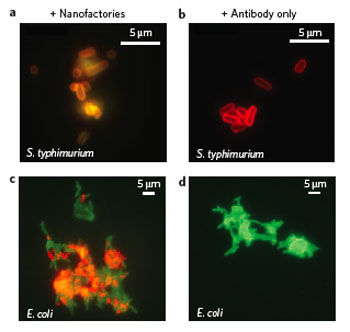
| Nanofactories effectively target bacteria in pure cultures and trigger their quorum sensing response. a,b, S. typhimurium LT2 targeted by nanofactories comprising Alexa Fluor 568 (red) labelled anti-Salmonella IgG and Alexa Fluor 488 (green) labelled HGLPT (a) or labelled anti-Salmonella alone (b). c,d, E. coli W3110 targeted by FITC (green) labelled anti-E. coli IgG and Texas Red-X (red) labelled HGLPT (c) and labelled anti-E. coli alone (d). (Reprinted with permission from Nature Publishing Group) | |
| The UMD team can trigger a quorum sensing response in the absence of a quorum by targeting the synthesis of the signal molecule directly onto targeted cells. What this does overall is open an avenue for interrupting bacterial communication networks by spatially organizing the synthesis at times or spatial locations that are particularly disruptive. | |
| This potentially opens the way for using these nanofactories in generating the next generation of antimicrobial treatments that target the communication networks of bacteria rather than their viability. That way, useful bacteria can be selectively harnessed while harmful ones can be switched off. | |
| "Our thought is that this modality may be useful to guide or direct phenotype for a specified outcome" explains Bentley. "For example, for use as a potential antibiotic: if we trigger a particular response before the cells are ready or have reached a significant density, neighboring cells or even macrophages might be able to attack the bacteria that otherwise might have sufficient density or be in a recalcitrant biofilm to avoid macrophage attack." | |
| The hope is that, ultimately, this will enable guided alteration of signaling that occurs among bacteria. Bentley points out that scientists may be able to guide mixed cell populations in a targeted manner. "Diseases that reside in intestinal tracts or dental locales may be treated using this technology. So might infections. If we can synthesize disruptors or even degrade signals in spatially defined locations, we can potentially keep harmful bacteria at bay." | |
| Another interesting demonstration of nanofactory utility is the creation of inter-species communication in bacterial co-cultures. The researchers were able to show that even in mixed cultures, cell-to-cell communication is 'created' between cells that do not normally communicate. | |
| This new work opens many avenues for understanding cell-cell communications processes that normally were done by genetic mutation and using mice or other difficult-to-characterize environments. | |
| "We now can do on a microfluid chip, what previously was not done at all" says Bentley. | |
| The researchers reported their findings in the January 17, 2010 online issue of Nature Nanotechnology ("Engineered biological nanofactories trigger quorum sensing response in targeted bacteria"). | |
 By
Michael
Berger
– Michael is author of three books by the Royal Society of Chemistry:
Nano-Society: Pushing the Boundaries of Technology,
Nanotechnology: The Future is Tiny, and
Nanoengineering: The Skills and Tools Making Technology Invisible
Copyright ©
Nanowerk LLC
By
Michael
Berger
– Michael is author of three books by the Royal Society of Chemistry:
Nano-Society: Pushing the Boundaries of Technology,
Nanotechnology: The Future is Tiny, and
Nanoengineering: The Skills and Tools Making Technology Invisible
Copyright ©
Nanowerk LLC
|
|
|
Become a Spotlight guest author! Join our large and growing group of guest contributors. Have you just published a scientific paper or have other exciting developments to share with the nanotechnology community? Here is how to publish on nanowerk.com. |
|
