
| Posted: Feb 28, 2007 | |
Carbon nanotubes can double the efficiency of photoelectrochemical solar cells |
|
| (Nanowerk Spotlight) The photocatalytic activity of nanostructured semiconductor films has been widely explored in designing solar cells, solar hydrogen production, and environmental remediation. Of particular interest is the dye-sensitized solar cell (DSSC) which uses nanostructured titanium dioxide films modified with sensitizing dyes. | |
| Despite the initial success of achieving 10% solar conversion efficiency, the effort to further improve their performance has not been very successful. A major hurdle in attaining higher photoconversion efficiency in such nanostructured electrodes is the transport of electrons across the particle network. The photogenerated electrons in nanostructured films for example have to travel through the network of semiconductor particles and encounter many grain boundaries during the transit. Such a random transit path for the photogenerated electrons increases the probability of their recombination with oxidized sensitizer. | |
| With the recent advance in the design of nanotube and nanowire architecture, it should be possible to use such one-dimensional nanostructures to direct the flow of photogenerated charge carriers. The obvious challenge is to use nanowire or nanotube networks as support to anchor light-harvesting semiconductor particles and facilitate the electron transport to the collecting electrode surface in a solar cell. | |
| Researchers now have demonstrated that single wall carbon nanotube (SWCNT) architecture when employed as conducting scaffolds in a titanium dioxide semiconductor based photoelectrochemical cell can boost the photoconversion efficiency by a factor of 2. | |
| There was a lot of interest in our last week's Nanowerk Spotlight "The impact of carbon nanotubes on the use of solar energy" so we are following up today with a detailed look at new research that improves the efficiency of solar cells with carbon nanotubes. | |
| Dr. Prashant V. Kamat, a professor of chemistry and biochemistry at Notre Dame University and a senior scientists at the university's Radiation Laboratory, and his team have developed a semiconductor nanoparticle-carbon nanotube hybrid assembly to improve the photoconversion efficiency of solar cells. | |
| "Currently efforts are underway to create ordered assemblies of semiconductor nanostructures, for example nanorods and nanowires on a conducting substrate, to improve the charge transport properties" Kamat explains to Nanowerk. "We have come up with a simple and innovative approach to employ single-walled carbon nanotubes as conducting wires in a solar cell." | |
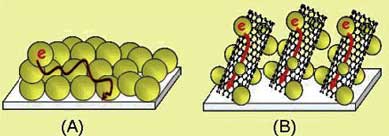 |
Electron transport across nanostructured semiconductor films: (A) in the absence and (B) in the presence of a nanotube support architecture. (Reprinted with permission from the American Chemical Society) |
| The unique electrical and electronic properties, wide electrochemical stability window, and high surface area render SWCNTs as scaffolds to anchor light-harvesting assemblies. The semiconducting SWCNTs have been shown to play an important role in improving the performance of organic photovoltaic cells and fuel cells. They also display photoelectrochemical effects under visible light irradiation. TiO2 and ZnO nanowires and nanotubes have also been employed in DSSC. | |
| Kamat and his team now have have successfully created SWCNT networks on a conducting carbon fiber and glass electrodes. The photoactive TiO2 nanoparticles are then dispersed on a conducting scaffold of SWCNTs. | |
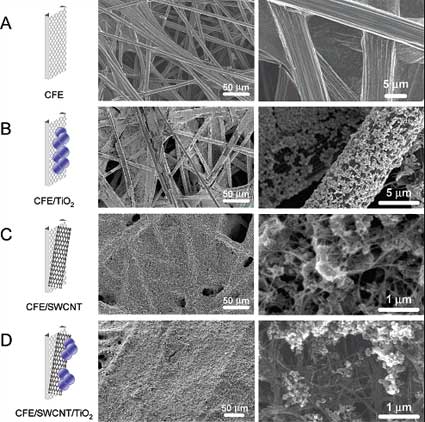 |
SEM of a carbon fiber electrode (CFE) at different stages of modification: (A) before surface modification; (B) after modification with TiO2 particles; (C) after electrophoretic deposition of SWCNT; (D) after deposition of TiO2 particles onto SWCNT film. (Reprinted with permission from the American Chemical Society) |
| "The SWCNT architecture provides a nanowire network to disperse TiO2 semiconductor nanoparticles" says Kamat. "The SWCNTs act as a conducting scaffold to facilitate charge collection and charge transport in nanostructured semiconductor films. As a result of the beneficial role of the SWCNTs we observed a twofold increase of photoconversion efficiency." | |
| There are several areas where this kind of nanowire/nanoparticle architecture is likely to play an important role: in improving the efficiency of nanostructure based solar cells, such as DSSC, or in water photoelectrolysis; in electronics where CNTs facilitate electron storage and transport; and optoelectronics where hybrid structures could be used for the optical modulation of charge transport properties. | |
| Already looking to improve this approach, Kamat and his team are working on designing aligned structures of nanotubes and maximizing the coverage of the semiconductor particles. In addition, they are trying to extend the response of these hybrid electrodes into the visible by attaching CdSe and PbSe quantum dots. | |
| Kamat's recent paper, titled "Single Wall Carbon Nanotube Scaffolds for Photoelectrochemical Solar Cells. Capture and Transport of Photogenerated Electrons" was published in the February 20, 2007 online edition of Nano Letters. | |
 By
Michael
Berger
– Michael is author of three books by the Royal Society of Chemistry:
Nano-Society: Pushing the Boundaries of Technology,
Nanotechnology: The Future is Tiny, and
Nanoengineering: The Skills and Tools Making Technology Invisible
Copyright ©
Nanowerk LLC
By
Michael
Berger
– Michael is author of three books by the Royal Society of Chemistry:
Nano-Society: Pushing the Boundaries of Technology,
Nanotechnology: The Future is Tiny, and
Nanoengineering: The Skills and Tools Making Technology Invisible
Copyright ©
Nanowerk LLC
|
Become a Spotlight guest author! Join our large and growing group of guest contributors. Have you just published a scientific paper or have other exciting developments to share with the nanotechnology community? Here is how to publish on nanowerk.com.