| Posted: May 21, 2010 | |
Stretchy and conductive nanotechnology composite for robot skin and strain sensors |
|
| (Nanowerk Spotlight) Electrically conductive composite materials capable of substantial elastic stretch and bending – conductive rubbers – is an industrially important field. The composites are needed for such applications as smart clothing, flexible displays, stretchable circuits, strain gauges, implantable devices, high-stroke microelectromechanical systems (MEMS), and actuators. | |
| A variety of approaches involving carbon nanotubes (CNTs) and elastic polymers have been suggested for the fabrication of conductive elastic composites. Various studies indicated that high loading of CNTs or other conductive additives into the polymer was necessary to obtain a highly conducting composite. | |
| On the other hand, incorporation of high concentrations of CNTs into an elastic binder increases the stiffness of the resulting composite and decreases its stretchability. In other words, the significant difference in the Young's modulus of extremely rigid CNTs and the elastic polymer binder makes the creation of a highly stretchable conductive composites a challenging task. | |
| A U.S.-Korean research team has now demonstrated that a combination of high stretchability and high electrical conductivity can be obtained for composites prepared from three-dimensional CNT structures, such as CNT forests (vertically aligned arrays of CNTs). | |
| "Unlike previous methods involving casting CNT/polymer dispersions in the form of a film, our composites were prepared by the direct infiltration of multiwalled carbon nanotube forests with a polyurethane solution," Mikhail Kozlov tells Nanowerk. "Using this procedure, we obtained rubber-like composites that combined high stretchability with high electrical conductivity. The developed preparation procedure appears scalable for material fabrication on an industrial scale." | |
| Kozlov is a Research Scientist at the NanoTech Institute, University of Texas at Dallas. Together with colleagues from the Institute as well as scientists from the Center for Bio-Artificial Muscle and Department of Biomedical Engineering at Hanyang University in South Korea, the team consisting of Min Kyoon Shin, Jiyoung Oh, Marcio Lima, Seon Jeong Kim and Ray Baughman prepared highly elastic and electrically conductive composite sheets by infiltration of multiwalled CNT (MWCNT) forests with a polyurethane binder. | |
 |
|
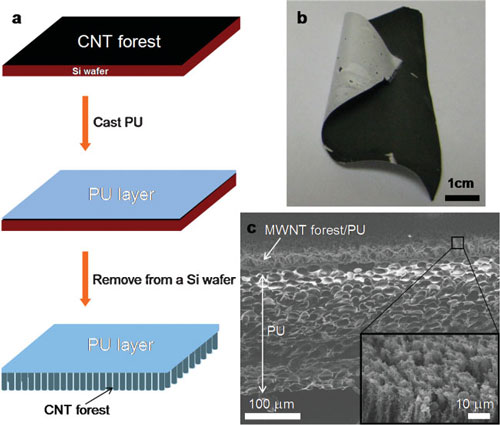
| a) Schematic diagram of the preparation method for the forest/PU composite sheet. b) Optical photograph showing opposite sides of the composite sheet. c) SEM image of the sheet cross section. A high-magnification SEM image of the black forest side is shown in the inset. (Reprinted with permission from Wiley-VCH Verlag) | |
| The researchers reported their findings in a paper in the May 5, 2010 online edition of Advanced Materials ("Elastomeric Conductive Composites Based on Carbon Nanotube Forests"). | |
| "After we pretreated the prepared composites by initial cycling, they provided highly reproducible changes in resistivity upon stretching for strains up to 40%" Kozlov explains. "We observed almost no degradation in electrical properties and linear dependence of resistivity on strain for strains in 10%–20% maximum range. The resistivity of the films showed little sensitivity to sheet twisting and bending." | |
| To fabricate their composite material, the team grew aligned arrays of MWCNTs with a typical diameter of about 10 nm and a height of 50 µm on iron-catalyst-coated silicon wafers using a conventional chemical vapor deposition (CVD) method. Kozlov notes that, since the nanotubes in the forests formed a three-dimensionally interconnected network, the forests were electrically conductive in all directions. | |
| The MWCNT forests were then infiltrated with a polyurethane (PU) solution using a simple drop-casting procedure. After evaporation of the solvent an approximately 250µm thick forest/PU composite sheets that could be peeled off the underlying silicon wafer. One side of the prepared film facing the substrate (forest side) was black and conductive, and the other side (PU side) was white and insulating. This material is soft, flexible, and highly stretchable in the sheet plane. | |
| The team notes that this preparation procedure can be easily extended for the fabrication of multi-layer samples by applying another PU or forest layer to the surface of the composite sheet. | |
| "As a result, sandwich structures of the type forest-PU-forest (conductive on both sides) or PU-forest-PU (conductive layer embedded into insulating PU) can be obtained" they say. "The structures retain outstanding elastic properties and high in-plane electrical conductivity." | |
| Electrical properties of prepared sheets revealed little sensitivity to twisting and bending deformations. After some conditioning, the zero strain resistance of samples typically changed only by 1%–2% in the next 100 cycles. | |
| According to the researchers, this evidences that the 3D structure of the MWNT forests in the PU matrix can effectively retain its original shape. The composite sheets will therefore work well in applications that require severe sensor bending or twisting, such as electronic textiles. | |
| Unlike conventional CNT/polymer composites, forest–based sheets have a very large strain-to-failure (over 1400%), high electrical conductivity at quite small overall nanotube loading, and show highly reversible changes in resistance in the moderate strain range (up to 20%). | |
| The researchers say that, because of the unique combination of high electrical and elastic properties, the CNT forest-based composites can be used for high deformation strain sensors, conducting clothes, skin-like materials with self-sensing capabilities, and highly stretchable electrodes for actuators and artificial muscles. | |
 By
Michael
Berger
– Michael is author of three books by the Royal Society of Chemistry:
Nano-Society: Pushing the Boundaries of Technology,
Nanotechnology: The Future is Tiny, and
Nanoengineering: The Skills and Tools Making Technology Invisible
Copyright ©
Nanowerk LLC
By
Michael
Berger
– Michael is author of three books by the Royal Society of Chemistry:
Nano-Society: Pushing the Boundaries of Technology,
Nanotechnology: The Future is Tiny, and
Nanoengineering: The Skills and Tools Making Technology Invisible
Copyright ©
Nanowerk LLC
|
|
|
Become a Spotlight guest author! Join our large and growing group of guest contributors. Have you just published a scientific paper or have other exciting developments to share with the nanotechnology community? Here is how to publish on nanowerk.com. |
|
