| Posted: Jul 09, 2010 | |
Nanotechnology converts heartbeat and breathing into electricity |
|
| (Nanowerk Spotlight) Several previous Nanotechnology Spotlights have covered the emerging field of nanopiezotronics, a term coined by Professor Zhong Lin Wang at Georgia Tech to describe the coupled piezoelectric and semiconducting property of nanowires and nanobelts for designing and fabricating novel electronic devices such as nanotransistors and nanodiodes. | |
| Biomechanical energy is one of the main energy components in biological systems. Developing an effective technique that can convert biomechanical energy into electricity is important for the future of in vivo implantable biosensors and other nanomedical devices. | |
| Last year, Wang's team – which has been developing nanogenerator technology since 2005 – has demonstrated that nanogenerators can be driven by irregular mechanical motion, such as the vibration of vocal cords, flapping of a flag in the breeze, tapping of fingers or hamsters running on exercise wheels ("Nanotechnology hamster power"). Scavenging such low-frequency energy from irregular motion is significant because much biomechanical energy is variable, unlike the regular mechanical motion used to generate most large-scale electricity today. | |
| "Recently, we have demonstrated the conversion of biomechanical energy into electricity by a muscle-movement-driven nanogenerator to harvest mechanical energy from body movement under in vitro conditions," Wang tells Nanowerk. "However, the applications of the nanogenerators under in vivo and in vitro environments are distinct. Some crucial problems need to be addressed before using these devices in the human body, such as biocompatibility and toxicity." | |
 |
|
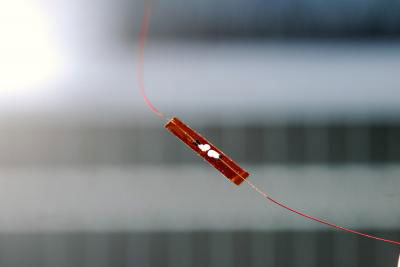
| A nanogenerator based on a single piezoelectric nanowire. (Image: Dr. Zhong Lin Wang, Georgia Institute of Technology) | |
| In a first demonstration of using nanotechnology to convert tiny physical motion into electricity in an in vivo environment, Wang's team has now reported ("Muscle-Driven In Vivo Nanogenerator") the implanting of a nanogenerator in a live rat to harvest energy generated by its breath and heartbeat. | |
| "Our study shows the potential of applying nanogenerators for the scavenging of low-frequency dynamic muscle energy created by very small-scale physical motion for the possible driving of in vivo nanodevices" says Wang. | |
| This video shows how a zinc oxide nanowire nanogenerator is used to generate electricity from the contraction and expansion of the beating heart of a iving rat. (Video: Dr. Zhong Lin Wang, Georgia Institute of Technology) | |
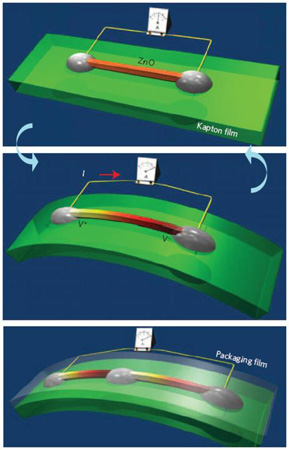
| The flexible power generator developed by the Georgia Tech team is based on cyclic stretching–releasing of a piezoelectric fine wire that is firmly attached to metal electrodes at both ends, is packaged on a flexible substrate, and does not involve sliding contacts. Repeatedly stretching and releasing a single wire with a strain of 0.05–0.1% creates an oscillating output voltage of up to approx. 50 mV, and the energy conversion efficiency of the wire can be as high as 6.8%. The fabrication process was described in detail in a paper in Nature Nanotechnology last year ("Power generation with laterally packaged piezoelectric fine wires"). | |
| For their experiments, the researchers used a piezoelectric zinc oxide nanowire, grown using a physical-vapor deposition process, with a diameter of 100-800nm and a length of 100-500µm. | |
| "We tightly fixed the two ends of the nanowire to the surface of a flexible polyimide substrate by applying silver paste and two lead wires, isolated from the environment, were connected to the ends," Wang describes the device structure. "Because of the presence of bio-fluids under the in vivo working condition, the entire device was covered with a flexible polymer to isolate it from the surrounding medium and to improve its robustness." | |
 |
|
| The schematic of the single-nanowire generator's structure and operation. (Image: Dr. Zhong Lin Wang, Georgia Institute of Technology) | |
| The first group of experiments was based on the conversion of the mechanical deformation related to the periodic expansion and contraction of the diaphragm of a rat into electricity. The nanogenerator was attached to the diaphragm surface by a tissue adhesive. The team measured a positive voltage/current pulse during inhalation, immediately followed by a negative voltage/current pulse during exhalation. On average, the magnitude of the voltage and current signals were about 1mV and 1 pA, respectively. | |
| A second group of experiments was geared to applying a nanogenerator to harvest mechanical energy from the heart beat of a live rat. Again, the nanogenerator was firmly attached to the surface of the heart with the help of the tissue adhesive. Here, the voltage and current outputs were around 3mV and 30 pA, respectively. | |
| "Our experiments clearly show that the in vivo application of our single-wire nanogenerator for harvesting biomechanical energy inside a live animal works," says Wang. "The nanogenerator has successfully converted the mechanical vibration energy from normal breathing and a heartbeat into electricity." | |
| He concludes that his team's research shows a feasible approach to scavenge the biomechanical energy inside the body, such as heart beat, blood flow, muscle stretching, or even irregular vibration. "This work presents a crucial step towards implantable self-powered nanosystems." | |
| The future direction of the team now is to test larger output nanogenerators under in vivo conditions. | |
 By
Michael
Berger
– Michael is author of three books by the Royal Society of Chemistry:
Nano-Society: Pushing the Boundaries of Technology,
Nanotechnology: The Future is Tiny, and
Nanoengineering: The Skills and Tools Making Technology Invisible
Copyright ©
Nanowerk LLC
By
Michael
Berger
– Michael is author of three books by the Royal Society of Chemistry:
Nano-Society: Pushing the Boundaries of Technology,
Nanotechnology: The Future is Tiny, and
Nanoengineering: The Skills and Tools Making Technology Invisible
Copyright ©
Nanowerk LLC
|
|
|
Become a Spotlight guest author! Join our large and growing group of guest contributors. Have you just published a scientific paper or have other exciting developments to share with the nanotechnology community? Here is how to publish on nanowerk.com. |
|
