
| Posted: Apr 10, 2007 | |
Novel nanocomposite material to combat white pollution |
|
| (Nanowerk Spotlight) Polystyrene (PS), also known under its trademark name styrofoam, is found in your home, office, local grocery, fast food outlet and in the cafeteria. It comes in many shapes and forms, from foam egg cartons and meat trays, plates and salad boxes, from coffee cups and utensils to CD jewel boxes, and from produce trays to those foam peanuts used in packing and the lightweight foam pieces that cushion new appliances and electronics. According to the U.S. Environmental Protection Agency's Municipal Solid Waste statistics (the things we read at Nanowerk to bring you interesting stories...), solid waste in the U.S. in 2005 contained almost 2.6 million tons of PS - a material that takes hundreds of years to break down and which is not recovered in recycling. PS is also a principle component of marine debris. Motivated by this problem of 'white pollution', a group of researchers in China developed a nanocomposite material that not only has superabsorbent capabilities but also utilizes waste PS foam. If commercially successful, this and similar methods of recycling waste PS into new products could go along way in reducing the worldwide harmful effects of white pollution. | |
| Superabsorbent materials have the ability to absorb many times their weight in aqueous solutions. They are used to improve the performance of a wide range of personal care products but also for industrial products such as plant-friendly water storage to improve soil quality, to regulate moisture in upholstered furniture and as a water-blocking component in cable sheaths. Remember the diaper commercials where they pour that blue stuff on the diapers and it disappears? What you saw was a superabsorbent in action. Superabsorbents are lightly crosslinked functional polymers that can absorb, swell, and retain aqueous solutions up to a thousand times of their own weight in relatively short period of time. | |
| A group of researchers at the Jiangsu Engineering Research Center for Biomedical Function Materials at Nanjing Normal University and the Jiangsu Technological Research Center for Interfacial Chemistry and Chemical Engineering at Nanjing University have developed a superabsorbent nanostructured composite with water absorbency of about 1200 times. | |
| "The main purpose of our work has two aspects" Dr. Jian Shen explains to Nanowerk: "One is to reduce the production cost of the superabsorbent material and at the same time promote its performance. The other is to find a new way to utilize waste PS foam. The introduction of PS chain into the nanocomposite not only reduces the production cost of the superabsorbent, but also improves the water absorbency rate." | |
| Professor Shen is the director of the Jiangsu Engineering Research Center for Bio-medical Function Materials at Nanjing Normal University in PR China. | |
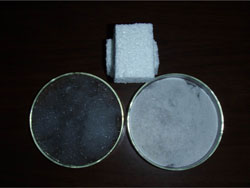
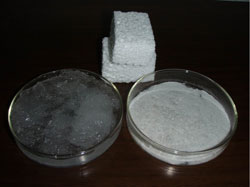
| Shen and his collaborators focused on crosslinked poly(acrylic acid), PAA, one of the most effective superabsorbents (and the stuff that is in baby diapers). They used partially neutralized acrylic acid (AA), montmorillonite (MMT) – a low-cost layered aluminum silicate – and waste polystyrene foam to create a novel superabsorbent nanocomposite. For their experiments they used ordinary polystyrene foam from the package of household electric appliances. | |
  |
|
| Waste PS and PS/AA/MMT superabsorbent (with 2.5 wt% MMT, before and after absorbing pure water) (Images: Dr. Jian Shen) | |
| "Not only does the use of waste polymer, especially hydrophobic polymer, for synthesizing superabsorbents distinguish our work from other research in this area, we also found that the introduction of PS chain to the composite not only reduced the production cost but improved the water absorbency rate as well" says Shen. | |
| In their experiments, the percentage range of waste PS used in the nanocomposite material was between 7.7% and approx. 20%. According to Shen, this could reduce the production cost of superabsorbent materials by approx. 2.9% - 8.7%. | |
| This research by the Chinese scientists creates a new way of utilizing waste PS foam. By converting waste PS into a functional polymer rather than dumping it in a landfill, the resulting materials could be used in water-related areas, such as water preservation material, leak prevention, matrices for enzyme immobilization, medicine carriers for controlled release, as well as everyday personal care products. | |
| If these results could be successfully included into industrial manufacturing processes this could mean a big step towards eliminating the problem of white pollution. | |
| Shen states that the future direction for their research will be hydrophilic biomaterial, for example wound dressing, catheters, artificial blood vessel, etc. "We construct hydrophilic or zwitterionic molecular structure on the surface of traditional polymeric materials to improve their blood compatibility and tissue compatibility" he says. "The largest challenge we are facing right now is to improve the biocompatibility of the material." | |
| This work, titled "Waste polystyrene foam-graft-acrylic acid/montmorillonite superabsorbent nanocomposite", was published in the February 27, 2007 online edition of Journal of Applied Polymer Science. | |
 By
Michael
Berger
– Michael is author of three books by the Royal Society of Chemistry:
Nano-Society: Pushing the Boundaries of Technology,
Nanotechnology: The Future is Tiny, and
Nanoengineering: The Skills and Tools Making Technology Invisible
Copyright ©
Nanowerk LLC
By
Michael
Berger
– Michael is author of three books by the Royal Society of Chemistry:
Nano-Society: Pushing the Boundaries of Technology,
Nanotechnology: The Future is Tiny, and
Nanoengineering: The Skills and Tools Making Technology Invisible
Copyright ©
Nanowerk LLC
|
Become a Spotlight guest author! Join our large and growing group of guest contributors. Have you just published a scientific paper or have other exciting developments to share with the nanotechnology community? Here is how to publish on nanowerk.com.