| Posted: Aug 04, 2010 | |
Roller painting plastic solar cells |
|
| (Nanowerk Spotlight) Solar cells that convert sunlight to electric power traditionally have been dominated by solid state junction devices, often made of silicon wafers. Thanks to nanotechnology, this silicon-based production technology has been challenged by the development of a new generation of solar cells based on thin film materials, nanocrystalline materials and conducting polymeric films. These offer the prospects of cheaper materials, higher efficiency and flexible features. Even the mass production of polymer solar cells is now within reach. | |
| While most most polymer solar cells are manufactured through a spin-coating process – a technology very useful for fabricating very thin and homogeneous film and for controlling the film thickness – spin-coating has several drawbacks with regard to its application to mass production: scale-up is problematic and the process is not continuous; it is impossible to fabricate flexible devices; the process is not only expensive and wasteful but the cost increases exponentially as the substrate size increases. | |
| To overcome these problems, Jaewoong Jung and Won Ho Jo from the Department of Materials Science and Engineering at Seoul National University have now introduced a highly efficient polymer solar cell fabrication method by a novel coating process – roller painting. | |
| "The roller painting process is easy-to-use, high throughput and the most widely used method for conventional painting" they say. "The substrate size for the roller painting is limitless, and the process cost is also low since it is a continuous process. A particular advantage of roller painting compared to other coating processes is ease of control of the film thickness and uniformity. Therefore, roller painting is a very promising process industrial use in thin film fabrication and organic electronics." | |
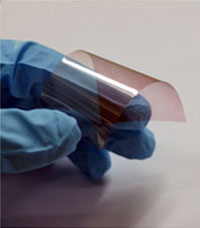
| Reporting their findings in a recent issue of Advanced Functional Materials ("Annealing-Free High Efficiency and Large Area Polymer Solar Cells Fabricated by a Roller Painting Process"), the two researchers demonstrate the fabrication of an only 40 nanometer thin polymer composite that was roller-painted on a large area (4cm x 8cm) PET film. | |
 |
|
| Large area P3HT:PCBM thin film fabricated by the roller painting on PET substrate. (Image: Dr. Won Ho Jo, Seoul National University) | |
| When they examined the film morphology by AFM, the Jung and Jo found that highly crystalline P3HT nanofibers are formed in the as-prepared film by roller painting. | |
| "The reasons for this high crystallization is the normal and shear stresses accompanied with the roller painting and slow drying," they explain. "The slow drying of the film may accelerate self-assembly of P3HT chains. Smooth surface is another feature of the roller painted film. The average root-mean-square roughness of the roller painted film (on average 2.9 nm) is much smaller than that of the spin coated film (on average 4.7 nm)." | |
| The team also found that the roller-painted polymer solar cells can achieve an efficiency of 4.5%. This is 20% higher than the optimum power conversion efficiency (PCE) of 3.9% of the spin-coated solar cells. Even without annealing, the roller painted solar cells achieved a PCE of 3.8%. | |
| When they examined the nanoscale morphology of the active layer by TEM, the scientists found that the roller-painted film exhibits an interesting morphology. They observed very dark, cilia-like nanocrystals ca. 20 nm wide and ca. 100 nm long. | |
| They point out that it is interesting to observe that these nanocrystals are well packed and aligned normal to the rolling direction. This morphological characteristic is even more pronounced after thermal annealing. They say that these nanocrystals must be grown from PCBM molecules, because the PCBM phase is darker than the P3HT phase in bright-field TEM. | |
| "The fact that PCBM nanocrystals can be developed through simple roller-painting is remarkable" says Jo. "Since the roller-painting process follows the basic process of the roll-to-roll processing, our research provides a model study for preparation of roll-to-roll processed organic electronics." | |
 By
Michael
Berger
– Michael is author of three books by the Royal Society of Chemistry:
Nano-Society: Pushing the Boundaries of Technology,
Nanotechnology: The Future is Tiny, and
Nanoengineering: The Skills and Tools Making Technology Invisible
Copyright ©
Nanowerk LLC
By
Michael
Berger
– Michael is author of three books by the Royal Society of Chemistry:
Nano-Society: Pushing the Boundaries of Technology,
Nanotechnology: The Future is Tiny, and
Nanoengineering: The Skills and Tools Making Technology Invisible
Copyright ©
Nanowerk LLC
|
|
|
Become a Spotlight guest author! Join our large and growing group of guest contributors. Have you just published a scientific paper or have other exciting developments to share with the nanotechnology community? Here is how to publish on nanowerk.com. |
|
