
| Posted: May 14, 2007 | |
Biolistic guns to shoot nanoparticle bullets into plant cells |
|
| (Nanowerk Spotlight) Most nanobiotechnology research today is focused on human medical applications and, mostly for testing and demonstration purposes, on animals. As nanotechnology is gaining interest with regard to agricultural applications, plant science research focusing on investigation of plant genomics and gene function as well as improvement of crop species has become a nanotechnology frontier. Plant cells differ from animal cells in several aspects, a major one being that they possess a wall surrounding them to provide, among other things, mechanical and structural support. The plant cell wall is generally made up of pollysacharides and cellulose. Cellulose provides a stiff and rigid environment for the cell to live in. Thanks to this wall, viruses have no active way of penetrating plant cells but rely on mechanical wounds or infected seeds for transmission. Researchers are commonly using surface-functionalized silica nanoparticles as nonviral nanocarriers for experimental drug and DNA delivery into animal cells but their use with plants so far was limited due to the cell wall. In a first demonstration of the utilization of porous nanoparticle materials for intracellular controlled release and gene transfer application in plants, researchers have used silica nanoparticles to penetrate the cell wall and deliver a payload into the cell. | |
| "Modifying our previous technique, where we demonstrated that mesoporous silica nanoparticles (MSNs) could be used successfully as transmembrane delivery system in animals cultures, we were now able to a fabricate a stimuli-responsive controlled release nanodevice for the delivery of two different biogenic species into plant cells and tissues" Dr. Victor S.-Y. Lin explains to Nanowerk. "Specifically, we showed that a honeycomb MSN system with 3-nm pores can transport DNA and chemicals into isolated plant cells and intact leaves." | |
| Lin, a professor of chemistry at Iowa State University and a senior researcher with the U.S. DOE Ames Laboratory, worked with colleagues from both institutions to make two specific modifications to their existing MSN system to be used with plant cells and tissues. | |
| First, they functionalized MSN with TEG (triethylene glycol) so the MSN could be internalized by the plant cell through endocytosis (a process whereby cells absorb material, for instance protein or DNA molecules, from the outside by engulfing it with their cell membrane. Then, they loaded the MSN pores with the payload (β-estradiol, which is a chemical trigger for a gene expression) and capped the ends with gold nanoparticles to keep the molecules from leaching out. The 10-15 nm-sized gold nanoparticles not only served as a biocompatible capping agent but also added weight to each individual MSN to increase the density of the resulting complex material (the "bullet"). Finally, they coated the MSN with DNA molecules encoding a marker gene of green florescent protein (GFP). The GFP gene expression is controlled by the presence of β-estradiol. | |
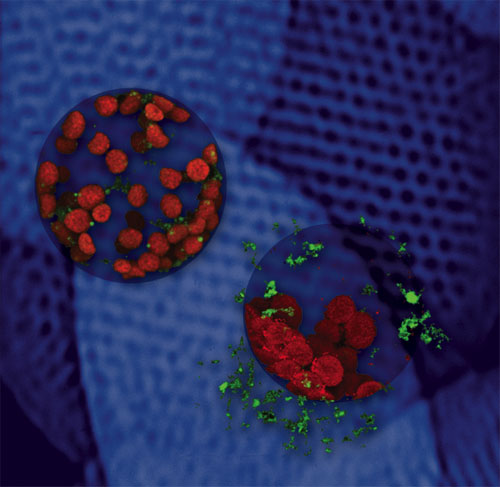 |
Confocal imaging of MSN uptake by tobacco mesophyll protoplasts. Protoplasts incubated wit Type-I MSNs (single focal plane image on the right) and Type-II MSNs (Type-I MSN functionalized with triethylene glycol, TEG) (three-dimensional reconstruction image on the left). No uptake of Type-I MSNs was observed but Type-II MSNs were internalized. Both MSNs are functionalized with fluorescein and visible in green. Autofluorescing chloroplasts in the protoplasts are in red. (Image: Dr. Lin) |
| Using what is called the biolistic gun approach, the researchers the successfully bombarded the MSN with their payload into the plant cells. Biolistic – short for biological ballistics – particle delivery is a method of transformation that uses helium pressure to introduce payload carriers into cells. This technique is much easier and faster to perform than the tedious task of micro-injection. | |
| Once inside the cell, chemical uncapping of the gold nanoparticles released the β-estradiol and triggered gene expression in the plants under controlled release conditions. | |
| Further developments such as pore enlargement and multifunctionalization of these MSNs may offer new possibilities in target-specific delivery of proteins, nucleotides and chemicals in plant biotechnology. | |
| "The MSN system may allow us to deliver RNA or small peptides, any molecules that can be encapsulated inside the pores" says Dr. Kan Wang, one of Lin's co-authors and a professor in the Plant Science Institute and the Department of Agronomy at Iowa State University. "Controlled release of these molecules in plant cells would allow us to study gene functions more effectively. Also, we may be able to deliver imaging agents to probe the changes of cellular environment when plant cells undergo different developmental and physiological stages." | |
| Lin, Wang, and their colleagues envision that this work could serve as a new design principle for future generation of smart nanodevices for target-specific delivery of proteins, genes, and chemicals in plant cells and tissues. | |
| "Future studies may provide breakthroughs to several current challenges and will further advance this burgeoning field of research" says Lin. "There are two key areas that we need to tackle: (1) Can the pore size be enlarged without compromising the overall particle size and shape of these nanomaterials? Bigger pores will allow the encapsulations of biological or other macromolecules, such as enzymes and functional polymers. (2) Can MSNs be designed to uncap under other conditions? For examples, can photo radiation, magnetic field, temperature, or other external stimuli be use a uncapping triggers to control the timing and rate of release of guest molecules from MSN?" | |
| The Iowa State researchers' findings, titled ("Mesoporous silica nanoparticles deliver DNA and chemicals into plants"), were published in the April 29, 2007 online edition of Nature Nanotechnology. | |
 By
Michael
Berger
– Michael is author of three books by the Royal Society of Chemistry:
Nano-Society: Pushing the Boundaries of Technology,
Nanotechnology: The Future is Tiny, and
Nanoengineering: The Skills and Tools Making Technology Invisible
Copyright ©
Nanowerk LLC
By
Michael
Berger
– Michael is author of three books by the Royal Society of Chemistry:
Nano-Society: Pushing the Boundaries of Technology,
Nanotechnology: The Future is Tiny, and
Nanoengineering: The Skills and Tools Making Technology Invisible
Copyright ©
Nanowerk LLC
|
Become a Spotlight guest author! Join our large and growing group of guest contributors. Have you just published a scientific paper or have other exciting developments to share with the nanotechnology community? Here is how to publish on nanowerk.com.