| Posted: May 05, 2011 | |
Stamping antibacterial nanoparticles onto wounds |
|
| (Nanowerk Spotlight) The potential use of antimicrobial surface coatings ranges from medicine, where medical device infection is associated with significant healthcare costs, to the construction industry and the food packaging industry. Thin films containing silver nanoparticles have been seen as promising candidate coatings. Silver is known as one of the oldest antimicrobial agents. Silver ions are thought to inhibit bacterial enzymes and bind to DNA. Silver nanomaterials have been used effectively against different bacteria, fungi and viruses (see for instance: "Antibacterial nanotechnology multi-action materials that work day and night"). | |
| Using something like an advanced form of a rubber stamp, scientists have now developed a way to adhere an ultra-thin (just a few molecules thick) antibacterial coating to a wound. The "stamped" area shows bactericidal activity for at least 48 hours. | |
| Reporting their findings in a recent paper in Advanced Functional Materials ("Polymeric Multilayers that Contain Silver Nanoparticles can be Stamped onto Biological Tissues to Provide Antibacterial Activity"), a research team from the University of Wisconsin-Madison, led by Nicolas Abbott, describes a process for creating a transparent ultra-thin polymer coating carrying precise loads of silver nanoparticles. | |
| A key innovation underlying the approach presented in this paper is a procedure that permits the mechanical transfer of pre-fabricated polymer thin films onto soft-biological tissue such as skin dermis (serving as a skin wound simulant). | |
 |
|
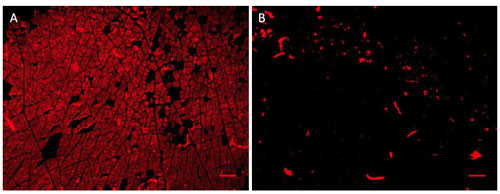
| Minimal transfer of (PAH/PAA)10(crimson-PS)(PAH/PAA)10 multilayers from poly(dimethylsiloxane) (PDMS) stamps onto the dermis of cadaver-skin when stamps were pressed against the skin-graft with a 500 g weight (pressure ∼50 kPa). (A) PDMS after stamping; (B) skin dermis after stamping. Red = 2 µm diameter crimson-fluorescent PS microspheres. Scale bar = 200 µm. (Reprinted with permission from Wiley-VCH Verlag) | |
| In previous work ("Surfaces modified with nanometer-thick silver-impregnated polymeric films that kill bacteria but support growth of mammalian cells"), the team addressed the challenge of delivering loadings of silver that are non-toxic but antibacterial to wound-beds. They did that by nanoscopic localization of carefully controlled loadings of silver nanoparticles within molecularly thin multilayer films of polymers on a surface. | |
| "Fabrication of polyelectrolyte multilayer (PEM) films and their impregnation with silver nanoparticles is a laborious process that involves hundreds of adsorption and rinsing steps and the use of non-physiological solutions such as reducing agents," explains Ankit Agarwal, the paper's first author. "For this reason, it is generally not practical to fabricate PEMs directly on biological tissues, including wound-beds." | |
| To address this limitation, the team developed a method that allows the pre-fabrication of PEMs loaded with silver nanoparticles on elastomeric stamps and the mechanical transfer of the silver-loaded PEMs onto the surfaces of biological tissues (the stamping process itself takes just 30 seconds). This approach avoids exposure of the biological materials to extensive chemical processing, and likely can be extended to the integration of a range of bioactive molecules (hosted within PEMs) onto the surfaces of biological tissues so as to confer useful functionality. | |
| The technology, developed in collaboration with Charles Czuprynski of UW-Madison and Christopher Murphy, who is now at the University of California, offers many benefits, says Agarwal. | |
| "First, it places the silver nanoparticles directly in the wound, allowing nontoxic silver doses – up to 100 times lower than what is used in commercial silver dressings – to have antibacterial activity. Second, chemical engineers should be able to make a sustained-release version to reduce the need for repeated applications and painful dressing changes." | |
| According to the researchers, their stamping method is applicable to a range of soft materials and could incorporate a variety of molecules onto the tissue surface that could influence fundamental cell behaviors involved in healing. | |
 By
Michael
Berger
– Michael is author of three books by the Royal Society of Chemistry:
Nano-Society: Pushing the Boundaries of Technology,
Nanotechnology: The Future is Tiny, and
Nanoengineering: The Skills and Tools Making Technology Invisible
Copyright ©
Nanowerk LLC
By
Michael
Berger
– Michael is author of three books by the Royal Society of Chemistry:
Nano-Society: Pushing the Boundaries of Technology,
Nanotechnology: The Future is Tiny, and
Nanoengineering: The Skills and Tools Making Technology Invisible
Copyright ©
Nanowerk LLC
|
|
|
Become a Spotlight guest author! Join our large and growing group of guest contributors. Have you just published a scientific paper or have other exciting developments to share with the nanotechnology community? Here is how to publish on nanowerk.com. |
|
