
| Posted: Jul 23, 2007 | |
Forecasting nanotechnology |
|
| (Nanowerk Spotlight) Forecasting technological developments is notoriously tricky. Many futurologists choose a safe 50 to 100 years timeframe to make sure they are dead, and the book royalties spent, when the forecasts are due (or they skip the science part altogether and write science fiction). A few months ago we introduced you to a "Detailed Roadmap of the 21st Century", a year by year bullet point list of notable advances expected to happen in the 21st century. | |
| There is no wiggling out - the names of the people or organization making a forecast is attached to it. Already there are some missed forecasts - 8 out of 13 since 2001. Then there is another type of forecast, favored by some consultants and investment advisors, that attempts to predict the dollar value of product markets within a timeframe much shorter than that of futurologists and sci-fi writers. | |
| Although this group of forecasters develops elaborate models and methodologies, the outcome is equally dubious (see our recent Nanowerk Spotlight "Debunking the trillion dollar nanotechnology market size hype"). A third type of forecast might be the most useful; here, the input comes from the group of people who live and breath the technology every day - the companies developing, building and selling products and services. | |
| Of course, the focus of this type of forecast necessarily becomes increasingly blurry as well as it looks into the future, but it tends to avoid the hyperbole and a lot of the speculative nature of other types of forecast. A recent UK study provides a purely industry-led forecast for nanotechnologies and examines industry's existing opinion of the economic potential for nanotechnologies. | |
| The Nanotechnology Industries Association (NIA) was formed in 2005 by a group of companies from a variety of industry sectors, including healthcare, chemicals, automotive, materials processing, and consumer products. It's members include such industry leaders as BASF, BP, Epson, Johnson & Johnson, Shell, and Unilever, just to name a few. You can find the full list on their website. In June, NIA released a study, titled "NIA Forecast of Emerging Technologies". It provides a purely industry-led forecast, which makes exclusive use of data obtained from the industrial members of the NIA. | |
| "Our study delivers a clear outline of the industrial development path for nanotechnology and its advancement over the next 15 years into more complex nanomaterials, structures and systems" Dr. Steffi Friedrichs, Director of NIA, explains to Nanowerk. "The forecast examines the existing opinion of the economic potential for nanotechnologies by our members and provides their view of the impact of these emerging technologies." | |
| Friedrichs points out that the NIA forecast is based on a flexible and dynamic framework that is not constrained by a rigid process-driven approach, but that can be applied to plot widely differing technologies on the same graph and compare them. The NIA effort is designed to be an ongoing exercise, where the framework is gradually populated with data provided by the industrial members of the NIA. | |
| "The forecast is reviewed regularly, in order to obtain an iterative identification of the industries' long-term aspirations" says Dr Paul Reip, Founder & CTO of QinetiQ Nanomaterials, who together with Friedrichs leads this forecast exercise. The creation and collection of company-specific information is designed to be an ongoing process, so that the resulting plot represents an initial snapshot of the dynamically changing forecast. NIA plans to update its forecast annually. | |
| "We anticipate that new aspects of nanotechnologies will be added, while others might be taken off the roadmap, or moved to a different position on the chart, according to their status of development" says Friedrichs. | |
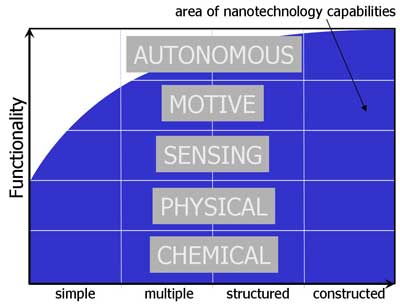
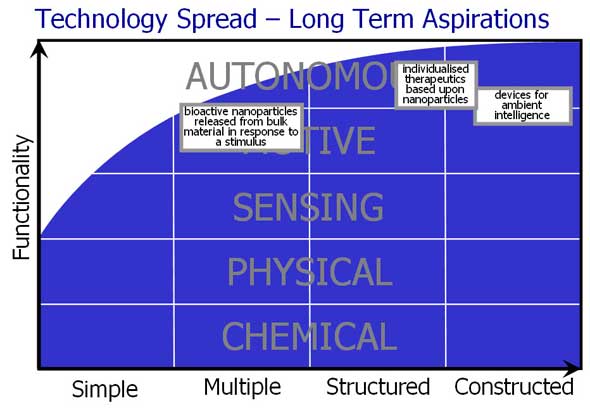
| Central to the NIA study is the model of progression with time and complexity; this attribute enables the simultaneous plotting of a number of different technologies, and results in an overview of wide ranging applications. The study attempts to capture this progression by plotting complexity (ranging from simple materials, sometimes already in manufacture on a large scale, to highly convoluted 2D and 3D constructs, that may still reside in the laboratory) against an increasing level of functionality (with system functionality increasing from chemical, over physical, sensing and motive to autonomous). | |
 |
|
| Division of the defining dimensions into several descriptive categories; the complexity of systems increases from simple systems, over multiple and structured to constructed systems, while the system functionality increases from chemical, over physical, sensing and motive to autonomous. (Image: NIA) | |
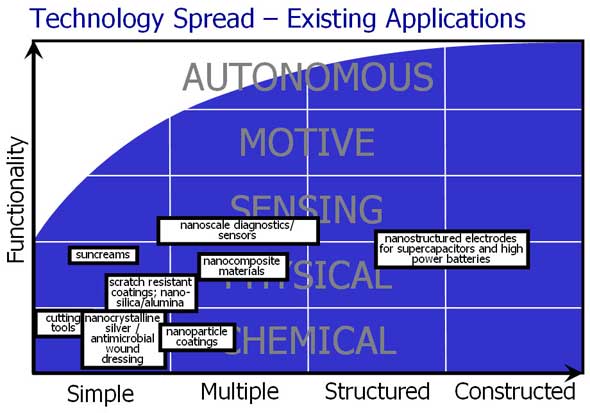
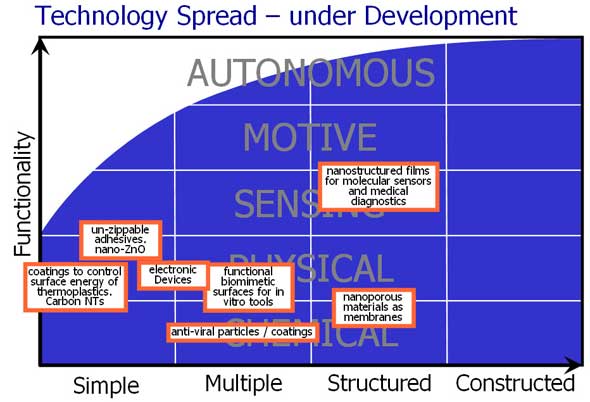
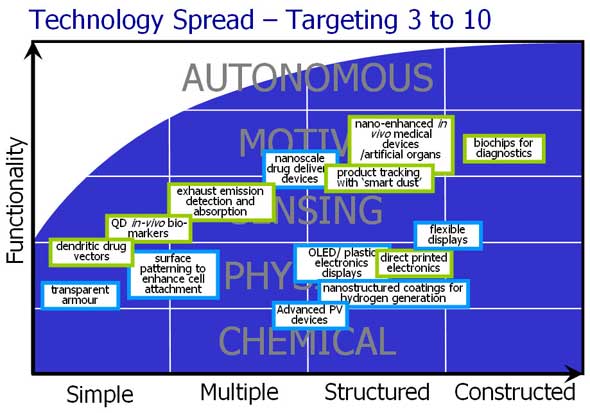
| During the initial survey phase, NIA?s industrial members provided data on nanotechnology-enabled components and systems at various stages of research, development and commercialization. The collected data was divided into four major categories – existing applications; current development/ready in 0-3 years; targeting 3-10 years; long-term aspirations: >10 years – and mapped into the 2-dimensional chart of nanotechnology capabilities. Here is an overview of the results: | |
 |
|
 |
|
 |
|
 |
|
| Click on a chart for a larger image | |
| To its credit, and probably because the input came from down to earth corporate types, the NIA report focuses more on the near end of the timescale and forgoes far-fetched scenarios in the 10+ years category. | |
| "It is important to note that those nanotechnologies currently under debate by regulators, industries, scientists and the public, as well as in various multi-stakeholder bodies, are mostly existing applications or ones under development" says Friedrichs. "The concerns raised by far-fetched science-fiction scenarios often focus on areas far away from where the leading edge of technology is taking us. We are currently not only lacking the tools that enable us to develop the long-term aspiration, but also the societal theories that could capture the impact of future technologies; both frameworks will need to be developed in parallel." | |
 By
Michael
Berger
– Michael is author of three books by the Royal Society of Chemistry:
Nano-Society: Pushing the Boundaries of Technology,
Nanotechnology: The Future is Tiny, and
Nanoengineering: The Skills and Tools Making Technology Invisible
Copyright ©
Nanowerk LLC
By
Michael
Berger
– Michael is author of three books by the Royal Society of Chemistry:
Nano-Society: Pushing the Boundaries of Technology,
Nanotechnology: The Future is Tiny, and
Nanoengineering: The Skills and Tools Making Technology Invisible
Copyright ©
Nanowerk LLC
|
Become a Spotlight guest author! Join our large and growing group of guest contributors. Have you just published a scientific paper or have other exciting developments to share with the nanotechnology community? Here is how to publish on nanowerk.com.