| Posted: Jan 12, 2012 | |
A microencapsulation strategy for enhanced protection from mosquito bites |
|
| (Nanowerk Spotlight) Repellents play an important role in protecting humans from insect bites. An effective and safe repellent is useful in reducing human-vector contact, and thereby helps in the interruption of vector-borne disease transmission – mosquito bites can cause causes diseases like dengue and malaria. There are two types of repellents – synthetic and natural. Some plant-based natural repellents are Lemon Eucalyptus, citronella, and lavender. | |
| N,N-diethyl-m-toluamide (DEET) is the best studied and most common active ingredient in insect repellents; it is also the most effective currently in the market. DEET modulates the physiological response of lactic acid (accompanied by human sweat) sensitive olfactory receptor neurons in the antennae of the mosquito like Aedes aegypti and inhibits the attraction to lactic acid. | |
| N, N-Diethylphenylacetamide (DEPA) is another long acting, inexpensive and broad spectrum multi-insect repellent1.It has attracted attention as an effective alternative to DEET in India due to the unavailability of m-toluic acid. The repellency effect of DEPA is similar to that of DEET in mosquitoes, black flies and land leeches, which has been tested on army personnel in field conditions2. The safety of DEPA has also been evaluated in rats3-5. | |
| Because of the nonavailability of m-toluic acid in India for the manufacture of DEET, there has been a need to develop an effective alternate and safe insect repellent. In total, 120 substituted amides were synthesized and tested for repellency at 1.5-2.0 mg/cm2 under laboratory conditions. | |
| Among these amides, DEPA applied at 1.5 mg/cm2 in different oil bases, was found to exhibit promising repellency (6-8 hours) in the laboratory when tested against Aedes aegypti. Diethyl phenyl acetamide (DEPA - C12H17NO) has been developed by Defence Research and Development Establishment at Gwalior, India. An extensive study has also been carried out for its bioefficacy and toxicity. The repellency of DEPA was evaluated on army personnel and compared with dimethylphthalate (DMP) and DEET against mosquitoes, black flies, and land leeches under field condition in the North-East Frontier area of India. | |
| Both DEPA and DEET displayed broad-spectrum repellency. DEPA was more effective than DMP against all test organisms. However, no significant difference was noticed between DEPA and DEET for repellency at 0.25 and 0.5 mg/cm2 against black flies and mosquitoes. | |
 |
|
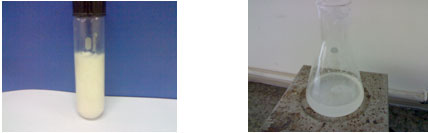
| Fig.1 (left): Cream prepared with Encapsulated DEPA and Standard cream base. Fig. 2 (right): Cross-linked sample solution containing repellent DEPA. (Images: Dr. Arpita Bhattacharya, Amity Institute of Nanotechnology) | |
| The use of DEPA in a vanishing cream – which is a pharmacologically safe polymer based on liquid and a lisosphere solution – has shown a maximum repellency up to 7.13 hours. But the direct mixing of DEPA is not recommended as it quickly escapes off the skin, when applied, and consequently the availability of DEPA on the skin decreases. Thus the desired long lasting repellency is not achieved. Hence, it needs to be encapsulated or entrapped into microcapsules. | |
| To be effective, a repellent must show an optimal degree of volatility, making it suitable as an effective repellent, and vapor concentration to be maintained at the skin surface without evaporating so that it does not quickly lose its effectiveness. Encapsulation with biodegradable polymers are perhaps the most promising way to fulfill the above criteria. | |
| In our recent study we developed a cream of microencapsulated DEPA (Fig.1) with two natural biodegradable polysaccharides (alginates and guar gum) (Fig.2). By adjusting the ratio of the two polysaccharides, the release of DEPA could be slowed down which prolongs the time of use with effective repellency. We found that the efficiency of mosquito repellency increased from 6 hours to 12 hours. No DEPA-based formulation with up to 12 hours of protection time has been reported so far. | |
 |
|
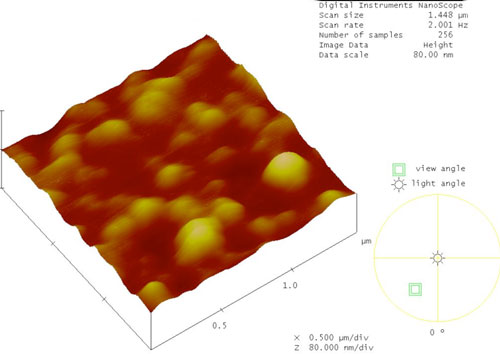
| Fig.3: 3-D AFM image of the surface topography of encapsulated DEPA. (Images: Dr. Arpita Bhattacharya, Amity Institute of Nanotechnology) | |
| We measured the particle size and distribution of the prepared microspheres of DEPA-calcium alginate using a Dynamic Light scattering Instrument (Malvern S-90 series) with a He-Ne laser beam at a wavelength of 633 nm at 25°C and at a scattering angle of 90°. Aliquots from each preparation batch were sampled in DLS cuvettes and then were examined for equivalent diameters, size distribution and polydispersity. The particle size obtained was around 350 - 450 nm (dia) with uniform size distribution. However, the particle size obtained by AFM ranges from 200 ? 250 nm with spherical and uniform distribution. The 2-D and 3-D AFM images of the encapsulated DEPA are shown in fig.3. | |
| The present work of developing the repellent cream has been carried out at Amity Institute of Nanotechnology, Amity University, Uttar Pradesh, Noida, India under a project sponsored by Defence Research and Development Organisation (DRDO). We thank Dr. S.N. Tikar, Scientist C, DRDE, Gwalior for helping in testing the mosquito repellency. | |
| References | |
| 1. Prakash, S., Kumar, S., Suryanarayana, M.V.S., Sharma, R.K.And Rao. K.M.(1988) Effectiveness of macrogol and talcum base formulations of a new insect repellent N,N-diethylphenylacetamide; Int. J.Cosmet. Sci, 10,23-28. | |
| 2. Kalyanasundram M, Mathew N, J Med Entomol. (2006), A safe and effective repellent for personal protection against hematophagous Arthropods; Journal of medical entomology, 43(3): 518-25. | |
| 3. Rao, S.S., Prakesh, S., kumar, S.,Kaveeshwar, U., Bhattacharya, B.K., Jaiswal, D.K. and Rao, K.M. (1987) Toxicologic studies of the insect repellent N,N-diethylphenylacetamide; Indian J. Med. Res., 85, 626-633. | |
| 4. Prakash, S., Rao, S.S., Kumar, and Rao, K.M. (1987) Studies on the effect on effect of N,N-diethyl phenyl acetamide- an insect repellent on fetus and reproduction in rats, Indian J. Pharm Sci,. 49, 220- 222. | |
| 5. Rao, S.S., Prakash, S. and Rao, K.M. (1988), Blood biochemical changes induced by insect repellent N,N-diethylphenylacetamide in rats; Indian J. Med. Res., 88, 76-84. | |
| By Dr. (Mrs) Arpita Bhattacharya, Asst. Prof., Amity Institute of Nanotechnology, Amity University, Uttar Pradesh, Noida ([email protected]) and Prof. R. P. Singh, Amity Institute of Nanotechnology, Amity University, Uttar Pradesh, Noida ([email protected])k | |
|
Become a Spotlight guest author! Join our large and growing group of guest contributors. Have you just published a scientific paper or have other exciting developments to share with the nanotechnology community? Here is how to publish on nanowerk.com. |
|
