| Posted: Oct 17, 2007 | |
Push-button nanotechnology |
|
| (Nanowerk Spotlight) As Bubba in Forrest Gump pointed out, there are lots of possibilities with shrimps: "You can barbecue it, boil it, broil it, bake it ... there's ah... pineapple shrimp, lemon shrimp, pepper shrimp, shrimp soup, shrimp stew, shrimp salad, shrimp burger, shrimp sandwich...that’s about it." It sounds pretty much the same when you listen to researchers talking about the numerous strategies for synthesizing nanoparticles - you can barbecue it, boil it, broil it, bake it (well, kind of) ... there's ah... sonochemical processing, cavitation processing, microemulsion processing, and high-energy ball milling. The problem is that, no matter what route you choose, nanoparticle synthesis is normally quite a tricky process that requires a lot of skill and expertise on the part of the chemist to obtain good quality particles of well controlled size and shape. Researchers in the UK tried to see if they could automate the whole procedure by preparing the nanoparticles in automated chemical reactors under the direct control of a computer. If successful, such reactors would find numerous applications in nanoscience and nanotechnology, especially in the areas of photonics, optoelectronics, bio-analysis and targeted drug delivery. | |
| "The difficulty of preparing nanoparticles in a controlled, reproducible manner is a key obstacle to the proper exploitation of many nanoscale phenomena" Dr. John de Mello a scientist at Imperial College in London, UK, explains to Nanowerk. Together with his brother Prof. Andrew de Mello and their PhD student Mr. Siva Krishnadasan, he set about designing a microfluidic system that would automatically optimize the emission wavelength of fluorescent nanoparticles. | |
 |
|
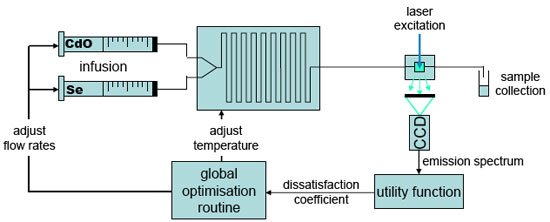
| Schematic of the automated reactor (Copyright: RSC Publishing) | |
| The system devised by the Imperial College scientists uses a microfluidic reactor to carry out the synthesis and an in-line spectrometer to monitor the emission spectra of the emergent particles. As they describe in their recent (free access) paper in Lab on a Chip ("Intelligent routes to the controlled synthesis of nanoparticles"),the acquired data is fed into a control algorithm which reduces each spectrum to a scalar 'dissatisfaction coefficient' and then intelligently updates the reaction conditions in an effort to minimize this coefficient and so drive the system towards a desired goal. | |
| "As far as I know, nothing quite like this has been tried before for nanoparticles" says de Mello. "Having said that, our approach draws heavily on existing work from several scientific disciplines: the chemical syntheses are proven ones from the scientific literature; the reactors are microfluidic devices – miniaturized chemical devices that have been the subject of intensive development for the past fifteen years; and the programs used to optimize the reaction conditions draw on techniques from the fields of applied mathematics and artificial intelligence that were originally developed with very different applications in mind." | |
| The researchers note that, so far, they have mainly used the automated reactors for preparing fluorescent quantum dots: The user specifies the emission wavelength (i.e. color) of the quantum dots and, by repeatedly updating the reaction conditions, the computer rapidly identifies conditions which yield particles that emit brightly at the desired wavelength. | |
| Quantum dots are particularly useful for optoelectronics and biosensors, but the automated reactors can also be used for making other types of nanoparticles. De Mello and his collaborators are already looking at ways of controlling the size and shape of metal and metal-oxide nanoparticles. | |
| "This is really just the beginning" says de Mello. "At the moment, everything we’re doing is quite simplistic and there’s plenty of scope for improvement. If everything goes to plan, this kind of automated approach has the potential to transform the efficacy of nanoparticle synthesis in terms of control, yield and ease-of-use." | |
 By
Michael
Berger
– Michael is author of three books by the Royal Society of Chemistry:
Nano-Society: Pushing the Boundaries of Technology,
Nanotechnology: The Future is Tiny, and
Nanoengineering: The Skills and Tools Making Technology Invisible
Copyright ©
Nanowerk LLC
By
Michael
Berger
– Michael is author of three books by the Royal Society of Chemistry:
Nano-Society: Pushing the Boundaries of Technology,
Nanotechnology: The Future is Tiny, and
Nanoengineering: The Skills and Tools Making Technology Invisible
Copyright ©
Nanowerk LLC
|
|
|
Become a Spotlight guest author! Join our large and growing group of guest contributors. Have you just published a scientific paper or have other exciting developments to share with the nanotechnology community? Here is how to publish on nanowerk.com. |
|
