| Posted: Nov 05, 2007 | |
For super-strong nanotechnology dry adhesives look no further than the gecko |
|
| (Nanowerk Spotlight) Animals that cling to walls and walk on ceilings owe this ability to micro- and nanoscale attachment elements. The highest adhesion forces are encountered in geckos. For centuries, the ability of geckos to climb any vertical surface or hang from ceilings with one toe has always generated considerable interest. A gecko is the heaviest animal that can 'stand' on a ceiling, with its feet over its head. This is why scientists are intensely researching the adhesive system of the tiny hairs on its feet. | |
| On the sole of a gecko’s toes there are some one billion tiny adhesive hairs called setae (3-130 micrometers in length), splitting into even smaller spatulae (about 200 nanometers in both width and length) at the end. It was found that these elastic hairs induce strong van der Waals forces. This finding has prompted many researchers to use synthetic microarrays to mimic gecko feet. | |
| Recent work, mainly from A. Dhinojwala, P.M. Ajayan, M. Meyyappan, and L. Dai groups, as well as the Max Planck Institute for Metals Research in Germany (see our previous Spotlight: Gecko nanotechnology), has indicated that aligned carbon nanotubes (CNTs) sticking out of substrate surfaces showed strong nanometer-scale adhesion forces. Although carbon nanotubes are thousands of times thinner than a human hair, they can be stronger than steel, lighter than plastic, more conductive than copper for electricity and diamond for heat. Applications of such bio-inspired development of artificial dry adhesive systems with aligned carbon nanotubes could range from low-tech fridge magnets to holding together electronics or even airplane parts. | |
 |
|
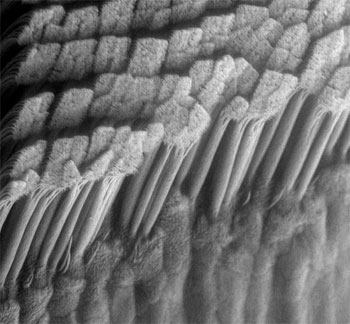
| Detailed view of gecko foot showing the elastic hairs called setae (3–130 µm in length) splitting into even smaller spatulae (0.2–0.5 µm in diameter) at the end. (Image: K. Autumn, E. Florance) | |
| University of Dayton researchers Professor Liming Dai and Dr. Liangti Qu have demonstrated that vertically-aligned single-walled carbon nanotube arrays could be used for a successful synthetic approach to mimic gecko foot-hairs to develop advanced dry adhesives with additional thermal/electrical management capabilities. | |
| "Although aligned multiwalled carbon nanotubes have been widely studied for many years, it is a recent effort to synthesize vertically-aligned single-walled carbon nanotube (SWCNT) arrays" Dai explains to Nanowerk. "Also, aligned multiwalled carbon nanotubes have just recently been used to mimic the gecko feet as dry adhesives. Having an extremely high aspect ratio, exceptional mechanical strength, and excellent electronic and thermal properties, the aligned single-walled carbon nanotubes show potential for dry adhesion applications with additional electrical/thermal management capabilities. The smaller nanotube diameter could also allow an aligned single-walled carbon nanotube array to have more contact points per unit surface area than its multi-walled counterpart, leading to an enhanced adhesion force for the aligned single-walled carbon nanotube dry adhesives." | |
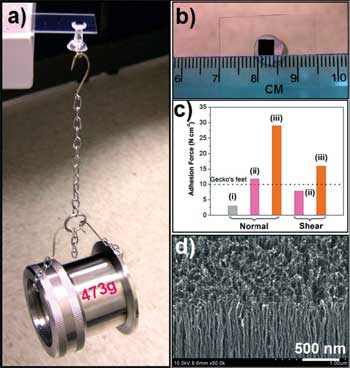
| In their recent work, reported in Advanced Materials ("Gecko-Foot-Mimetic Aligned Single-Walled Carbon Nanotube Dry Adhesives with Unique Electrical and Thermal Properties"), Dai and his group have demonstrated that their vertically aligned SWCNT arrays, measuring 4x4 square millimeters, have a much higher achievable macroscopic adhesive force (29 Newton per square centimeter) than natural gecko feet (which achieve about 10 Newton per square centimeter). | |
 |
|
| A photo showing a stainless steel adapter of 473 g hanging on a SiO2/Si-wafer supported vertically aligned SWCNT dry adhesive film (4mm x 4mm); b) pre-pressed (∼2 kg) from the Si side onto a horizontally-placed glass surface; c) a comparison of the maximum achievable adhesion forces for (i) microfabricated polymer hairs, (ii) vertically aligned MWCNT, and (iii) the as-grown aligned vertically aligned SWCNT. The dashed line represents the adhesion force for gecko feet; and d) a side-top viewSEMimage of the vertically aligned SWCNT film under a high magnification. (Reprinted with permission from Wiley) | |
| What this means is that only 150 pieces of these small SWCNT arrays, with a total contact area of about 5x5 square centimeters – which is much smaller than the palm of your hand – would be needed to collectively hold a person of ca. 70 kg. | |
| Dai's group also found that these vertically-aligned SWCNT dry adhesives showed fairly reversible semiconducting behaviors under load and an excellent thermal resistance due to the unique thermal and electric properties intrinsically associated with SWCNTs. | |
| "Such aligned SWCNT dry adhesives with thermal and electrical management capabilities will open up avenues for many novel applications of carbon nanotubes, ranging from optoelectronics through household products (e.g. smart dry adhesives) and robotic systems to electronic packaging" says Dai. "Going forward, it is important for researchers to push these materials toward real applications in electronic packaging that requires thermal and electrical management capabilities (e.g. through thickness current/heat transport)." | |
| Further research on these carbon nanotube 'gecko feet' could lead to multifunctional smart dry adhesives (e.g. photo-sensitive or optoelectronically active) attractive for diverse potential applications. | |
| Dai points out that the possibility of using vertically aligned SWCNTs to mimic gecko feet has not yet been exploited largely because it is still at the state of art to repeatedly synthesize high quality arrays at a large-scale and in a cost-effective manner – which still remains a big challenge. Overcoming this challenge should facilitate the research and development of aligned SWCNT dry adhesives with enhanced multifunctional performance. | |
| This in turn would then allow for a large-scale preparation of CNT dry adhesives that could be repeatedly used in a variety of practical applications. | |
 By
Michael
Berger
– Michael is author of three books by the Royal Society of Chemistry:
Nano-Society: Pushing the Boundaries of Technology,
Nanotechnology: The Future is Tiny, and
Nanoengineering: The Skills and Tools Making Technology Invisible
Copyright ©
Nanowerk LLC
By
Michael
Berger
– Michael is author of three books by the Royal Society of Chemistry:
Nano-Society: Pushing the Boundaries of Technology,
Nanotechnology: The Future is Tiny, and
Nanoengineering: The Skills and Tools Making Technology Invisible
Copyright ©
Nanowerk LLC
|
|
|
Become a Spotlight guest author! Join our large and growing group of guest contributors. Have you just published a scientific paper or have other exciting developments to share with the nanotechnology community? Here is how to publish on nanowerk.com. |
|
