
| Posted: Mar 23, 2006 | |
CNTs as templates for one-dimensional nanoparticle assemblies |
|
| (Nanowerk News) Spanish researchers have shown that carbon nanotubes (CNTs) constitute the ideal templates for the formation of one-dimensional strings of metal nanoparticles, with potential uses as waveguides, that would allow the miniaturization of devices below the diffraction limit and as catalytic motors. | |
 |
|
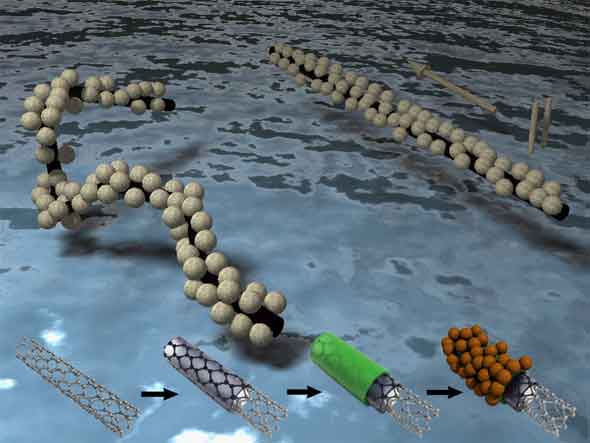
| Scheme of the layer-by-layer assembly process on CNTs. It shows the structure of CNTs covered with magnetic nanoparticles in the absence (left) and presence (right) of an applied magnetic field. (Source: Professor Liz-Marzán) | |
| Over the past years, researchers improved their capabilities for the creation of useful nanostructured components. To do that they developed a number of methods for tailored nanoparticle assemblies, each focusing on a particular interaction force between nanoparticles. One of them, the layer-by-layer (LBL) assembly method, offers very broad applicability and has become popular for the assembly of nanoparticle mono- and multilayers on macroscopic surfaces as well as the production of micropatterns and assembly on mesoscopic and microscopic substrates. | |
| In spite of these advances, the uniform assembly of nanoparticles into one-dimensional arrays over relatively long distances is still a challenge. | |
| Professor Luis Liz-Marzán, who heads the Nanoparticles and Nanostructures Group at the University of Vigo in Spain, explained to Nanowerk: "Linear arrays would have extremely interesting applications, for instance, in the construction of nanoelectronic circuits, but could also be used in photonics, since wave guiding via surface plasmons has been predicted for metal nanoparticle chains." | |
| Liz-Marzán told Nanowerk about their recent work where they used CNTs as one-dimensional templates for the fabrication of aligned assemblies of gold nanoparticles, resulting in single, optically labelled CNTs. | |
| "Apart from imparting very special optical properties to CNTs, this technique has a very good potential for the preparation of surface plasmon-based waveguides that would allow the miniaturization of devices below the diffraction limit." | |
| "Gold nanoparticles can be coated with silica shells of tailored thickness, which can subsequently be assembled on the CNTs" says Liz-Marzán. "The shell thickness can be engineered to achieve the necessary separation between gold nanoparticles to optimize wave guiding." | |
 |
|
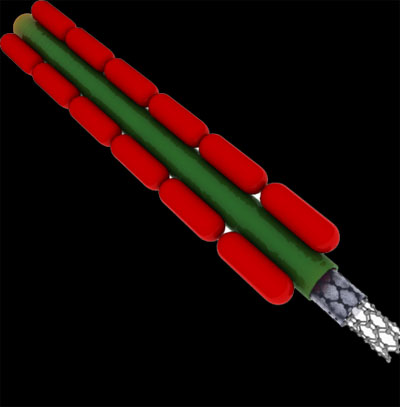
| Schematic drawing of Au nanorods assembled on a CNT in an aligned fashion. (Source: Professor Liz-Marzán) | |
| The working wavelength can be easily tuned through the dimensions and shapes of the nanoparticles. | |
| "We have also demonstrated that by assembling nanorods on the CNTs, the alignment of the CNTs themselves within polymer films can be monitored through the polarization-dependent optical response of the gold nanorods." says Liz-Marzán. | |
| Given the universality of the LBL process, the procedure outlined by the Spanish researchers has the potential to be applied for the creation of a large variety of one-dimensional nanoparticle assemblies. | |
| Ultimately, the ability to control the size, shape, loading, and dispersion of nanocrystals onto conductive CNTs will be extremely relevant for addressing some of the fundamental issues in many practical applications including fuel cell catalysis, nanodevices, quantum wires, ultrahigh-strength engineering fibers, sensors, and catalyst supports. | |
| Liz-Marzán and a member of his group, Miguel Correa-Duarte, published their findings, titled "Carbon nanotubes as templates for onedimensional nanoparticle assemblies" in issue 13 of Journal of Materials Chemistry. | |
| In a recent piece of work titled " Alignment of Carbon Nanotubes under Low Magnetic Fields through Attachment of Magnetic Nanoparticles" in the September 24, 2005 online edition of Physical Chemistry B the researchers also showed that CNTs can be aligned using an external magnetic field, when they are homogeneously covered with magnetic nanoparticles. In another recent paper "Photoluminescence Quenching Control in Quantum Dot-Carbon Nanotube Composite Colloids Using a Silica-Shell Spacer" published in the Jan. 25, 2006 online edition of Advanced Materials, they demonstrate the adsorption of semiconductor quantum dots on CNTs. | |
 By
Michael
Berger
– Michael is author of three books by the Royal Society of Chemistry:
Nano-Society: Pushing the Boundaries of Technology,
Nanotechnology: The Future is Tiny, and
Nanoengineering: The Skills and Tools Making Technology Invisible
Copyright ©
Nanowerk LLC
By
Michael
Berger
– Michael is author of three books by the Royal Society of Chemistry:
Nano-Society: Pushing the Boundaries of Technology,
Nanotechnology: The Future is Tiny, and
Nanoengineering: The Skills and Tools Making Technology Invisible
Copyright ©
Nanowerk LLC
|
Become a Spotlight guest author! Join our large and growing group of guest contributors. Have you just published a scientific paper or have other exciting developments to share with the nanotechnology community? Here is how to publish on nanowerk.com.