
| Posted: Jan 16, 2008 | |
Nanotechnology scavengers for heat wasted from burning fossil fuels |
|
| (Nanowerk Spotlight) One statement of the second law of thermodynamics is that the efficiency of any heat engine or other thermodynamic process is always less that 100%. There will always be some type of friction or other inefficiency that will generate waste heat. The useful work that a heat engine can perform will therefore always be less than the energy put into the system. Engines must be cooled, as a radiator cools a car engine, because they generate waste heat. While there is no way around the second law of thermodynamics, the performance of today's power generation technology is quite appalling. The average efficiency today for fossil-fired power generation, 35% for coal, 45% for natural gas and 38% for oil-fired power generation. By the way, be skeptical when people tell you that nuclear power is good in the fight against global warming - nuclear power plants have a worse thermal efficiency (30-33%) than fossil-fired plants. Approximately 90% of the world's power is generated in such a highly inefficient way. In other words: every year some 15 billion kilowatts of heat is dumped into the atmosphere during power generation (talk about fueling global warming...). This is roughly the same amount as the total power consumption of the world in 2004. Reducing these inefficiencies would go a long way in solving the coming energy and climate problems. Thermoelectric materials - which can directly convert heat into electricity - could potentially convert part of this low-grade waste heat. Problem is that good thermoelectric materials are scarce and so far solid-state heat pumps have proven too inefficient to be practical. Two papers in this week's Nature describe how silicon devices could in principle be adapted and possibly scaled up for this purpose. | |
| Scientist have been trying for years to use nanotechnology to create novel semiconducting materials that could finally make thermoelectricity a widely used technology. Simply put, a thermoelectric device creates a voltage when there is a different temperature on each side (and vice versa, when a voltage is applied to it, it creates a temperature difference). The best thermoelectric material available is a compound of bismuth and tellurium, which is far too expensive to scale up to industrial scales for waste heat scavenging. But the main problem with thermoelectric materials is that, in order to make the conversion process efficient, the material should be good in conducting electricity, but not good in conducting heat (because that would reduce the temperature difference needed for the conversion). | |
| Which makes it very surprising that nanotechnology researchers have now been able to demonstrate that semiconductor nanowires can be designed to achieve extremely large enhancements in thermoelectric efficiency. Bulk silicon is a very inefficient thermoelectric material. It conducts heat so well that is is difficult to produce a temperature difference big enough to generate any useful voltage at all. | |
 |
|
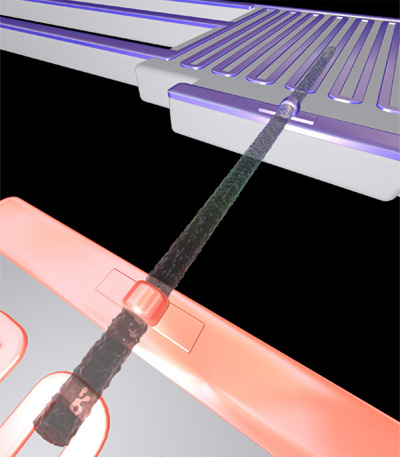
| Illustration for rough silicon nanowire bridging two suspended heating pads. Pads are Si3N4 membranes, one serving as heating source, the other a sensing pad. Color gradient represents the temperature gradient during measurement (Illustration: Benjamin Utley) | |
| In a paper in this week's Nature, the research group of Peidong Yang at Berkeley shows how the thermoelectric properties of silicon can be markedly improved by electrochemical synthesis of arrays of roughened silicon nanowires. The roughening introduces defects that substantially reduce the nanowires' thermal conductivity, holding promise for thermoelectric applications.("Enhanced thermoelectric performance of rough silicon nanowires") | |
| In a related paper, also in Nature, the research group of James R. Heath at Caltech also demonstrates an improvement in the thermoelectric performance of silicon nanowires, this time by controlling the size of the nanowires and by doping them. ("Silicon nanowires as efficient thermoelectric materials") | |
| In both cases, the thermoelectric performance of silicon has been improved by about 100 times – i.e. the thermal conductivity has been reduced by a factor of 100 – all of a sudden propelling ubiquitous and cheap silicon into the league of much higher priced efficient thermoelectric materials. | |
| The explanation for this amazing result lies in the nanoscale. The the introduction of nanostructures (nanowires) at different length scales (diameter, roughness and point defects) causes efficient scattering throughout the phonon spectrum. Put in simple terms: Heat is carried by phonons and charged particles. Introducing obstacles to these particles at the nanoscale structure of silicon reduces the heat flow. | |
| This theory indicates that similar improvements should be achievable for other semiconductor nanowire systems because of these phonon effects. Nanowire thermoelectrics may find applications related to on-chip heat recovery, cooling and power generation. Additional improvements through further optimization of nanowire size, doping and composition should be possible. | |
 By
Michael
Berger
– Michael is author of three books by the Royal Society of Chemistry:
Nano-Society: Pushing the Boundaries of Technology,
Nanotechnology: The Future is Tiny, and
Nanoengineering: The Skills and Tools Making Technology Invisible
Copyright ©
Nanowerk LLC
By
Michael
Berger
– Michael is author of three books by the Royal Society of Chemistry:
Nano-Society: Pushing the Boundaries of Technology,
Nanotechnology: The Future is Tiny, and
Nanoengineering: The Skills and Tools Making Technology Invisible
Copyright ©
Nanowerk LLC
|
Become a Spotlight guest author! Join our large and growing group of guest contributors. Have you just published a scientific paper or have other exciting developments to share with the nanotechnology community? Here is how to publish on nanowerk.com.