
Nanotechnology standards |
|
| (Nanowerk Spotlight) Most people in the world know exactly how long a kilometer is, how large a liter is, how much a kilogram weighs, and how warm 25°C is. That's because almost all countries in the world have adopted a standard called the metric system - since the 1960s the International System of Units has been the internationally recognized standard system for measurements (only three countries have not adopted this standard: Liberia, Myanmar, and the United States – the latter maybe because the metric system was invented by the French...). | |
| The lack of a unified standard, or the existence of different standards, can have dire consequences. In 1999, the Mars Climate Orbiter spacecraft was destroyed because a navigation error caused the spacecraft to fly too deep into the atmosphere of Mars. This error arose because a NASA subcontractor used Imperial units (pound-seconds) instead of the NASA-specified metric units (newton-seconds) in a navigation-related software. But even in the U.S., economic and scientific needs assure the continued creeping adoption of the metric standard in various areas. | |
| Nanotechnology is such a case, were the metric system is the undisputed only standard – used even by U.S. researchers – and sparing us conversion tables for nanometer to nanoinch and nanofoot, and nanoliter to nanogallon. | |
Standards go beyond just agreeing measurements |
|
| Standards have a much larger role in our society than just agreeing measurements. There are two different types of standards: physical measurement standards (for basic measurement quantities such as mass, time and frequency, which are traceable to the International System of Units (SI)) and documentary standards (written agreements among producers and/or users of products and services containing technical specifications or other precise criteria that may contain rules, guidelines, or definitions of characteristics). | |
| Put at its simplest, a standard is an agreed, repeatable way of doing something. It is a published document that contains a technical specification or other precise criteria designed to be used consistently as a rule, guideline, or definition. Standards help to make life simpler and to increase the reliability and the effectiveness of many goods and services we use. They are intended to be aspirational – a summary of good and best practice rather than general practice. | |
 |
|
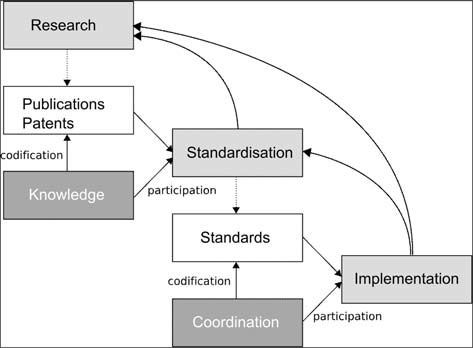
| Research and standardisation in a simple technology transfer model. (© Springer) | |
| Standards are designed for voluntary use and do not impose any regulations. However, laws and regulations may refer to certain standards and make compliance with them compulsory. For example, the physical characteristics and format of credit cards is set out in standard number BS EN ISO/IEC 7810:1996. Adhering to this standard means that the cards can be used worldwide. | |
| If we didn't have standards in our everyday lives, from things like coffemakers to cell phones, CDs and cars, life would be pretty complicated and much more expensive. Just think about the inconvenience every international traveler has experienced when it comes to the international incompatibility of plugs and sockets. | |
| Standards create comparability and any standard is a collective work. Committees of manufacturers, users, research organizations, government departments and consumers work together to draw up standards that evolve to meet the demands of society and technology. | |
| Standards exist at different levels and with different scopes: national standards such as ANSI in the U.S. or DIN in Germany; regional standards such as the EN standards in the European Union or the standards set by the Pan American Standards Commission; and international standards such as the IEC and ISO standards that are recognized by a large number of countries around the world. | |
Nanotechnology standards |
|
| The need for standardization also exists in various fields of nanotechnology in order to support commercialization and market development, provide a basis for procurement, and support appropriate legislation/regulation. Especially the vital role of standards in the emerging debate on nanotechnology risk assessment cannot be overestimated. The lack of nanotechnology standards poses several major challenges because right now there are: | |
|
|
|
|
|
|
| The major nanotechnology standardization efforts of Standards Development Organizations (SDOs) were initiated in the early to mid-2000s. These organizations around are active in defining nanotechnology standards, although no one standard has achieved dominance yet. The important SDOs are: | |
|
|
|
Towards a nanotechnology nomenclature and terminology |
|
| Ultimately, nanotechnology will require agreed international standards. One of the first tasks on everyone's plate – and the fundamental building block for any emerging industry – is a consistent and globally-accepted nomenclature and terminology. Without a precise and widely accepted terminology, communications about nanotechnology's risks and benefits are riddled with overgeneralizations. For example, the term 'carbon nanoparticles' often is used to describe in one phrase a range of very diverse nanomaterials such as fullerenes, single-, double-, or multi-walled carbon nanotubes, and even diesel exhaust. | |
| This seemingly simple issue of globally agreed terminology and definitions is surprisingly difficult. Even in the year 2019, the European Commission saw the need to release a report ("The EU gets specific about nanomaterials") that provides recommendations for a harmonized and coherent implementation of the nanomaterial definition in any specific regulatory context at European Union and national level. And this concerns only Europe! (also read: "Definition of the term 'nanomaterial'") | |
| Following the nanotechnology terminology, the next requirements on everyone's list are specifications and tests needed to support nanoscale measurement and characterization; as well as how nanotechnology will impact health, safety and the environment. | |
| Globally accepted nanotechnology standards will support worker, public and environmental safety and underpin commercialization and procurement of nanotechnologies in various industries. Given the current discussion about the potential risks of engineered nanomaterials, one of the key functions of nanotechnology standards will be the safety aspect of products. | |
| Today, products that contain nanomaterials, especially in the food and cosmetics industry, don't require any special labeling. Once the appropriate standards have been developed and accepted, product labels could refer to these standards, assuring the consumer that this particular product has undergone rigorous safety testing based on best practice and is considered safe. | |
 By
Michael
Berger
– Michael is author of three books by the Royal Society of Chemistry:
Nano-Society: Pushing the Boundaries of Technology,
Nanotechnology: The Future is Tiny, and
Nanoengineering: The Skills and Tools Making Technology Invisible
Copyright ©
Nanowerk LLC
By
Michael
Berger
– Michael is author of three books by the Royal Society of Chemistry:
Nano-Society: Pushing the Boundaries of Technology,
Nanotechnology: The Future is Tiny, and
Nanoengineering: The Skills and Tools Making Technology Invisible
Copyright ©
Nanowerk LLC
|
Become a Spotlight guest author! Join our large and growing group of guest contributors. Have you just published a scientific paper or have other exciting developments to share with the nanotechnology community? Here is how to publish on nanowerk.com.