| Posted: Jul 07, 2008 | |
Nanotechnology is revealing when it comes to fingerprints |
|
| (Nanowerk Spotlight) Archaeological evidence indicates that ancient Chinese and Babylonian civilizations already were using fingerprints to sign legal documents as early as 1000 BCE. As early as 1880, Dr Henry Faulds, an English physician working in Tokyo, published a letter in the journal Nature suggesting the use of fingerprints for identification purposes. Today, fingerprints are still the primary method of identification of criminals although the techniques for fingerprint detection and enhancement have become hi-tech and involve nanotechnology applications. Some researchers even want to make it possible to use fingerprints to reveal drug and doping transgressions and to diagnose diseases (Nanotechnology fingerprint analysis could replace blood sample). | |
| The most problematic of fingerprints are latent prints that are not readily visible and that require development by chemical and/or physical means. Usually, the choice of the technique for fingerprint development is dependent on the composition of latent fingerprints, on the type of substrate and on the ability of the technique to be applied in sequence in the context of the case. | |
| A new review paper describes the current status of nanotechnology-based techniques such as application of metal-containing nanoparticles and nano-structured particles to fingermark detection. It concluds that nanotechnology is likely to play a major role in the future to deliver more selective and more sensitive ways to detect and enhance fingermarks. | |
| "It is generally accepted that only a subset of all the latent fingermarks present on an exhibit are actually detected," Dr. Philip Maynard tells Nanowerk. "In other words, in routine casework, a non-negligible number of latent fingermarks probably remain undetected, and consequently cannot be exploited during the investigation. This explains why the demand for improved reagents for fingerprint development has continued in forensic science over the years." | |
| Maynard, a lecturer at the University of Technology Sydney (UTS) and a forensic scientist with expertise in the areas of trace evidence and chemical/arson analysis, explains that the fingermark is a complex mixture of natural secretions of the body (mostly sweat from different types of glands) and contaminations from the environment. | |
| "Secretions from three types of glands – eccrine, apocrine, and sebaceous – may be present in latent fingermarks. The constituents of the deposit are mostly water (99%) and minor amounts (up to 1%) of inorganic and organic compounds. Eccrine secretions are present to some degree in every latent fingermark but the composition varies in relation to age, sex, medical condition and diet along with environmental conditions post-deposition." | |
 |
|
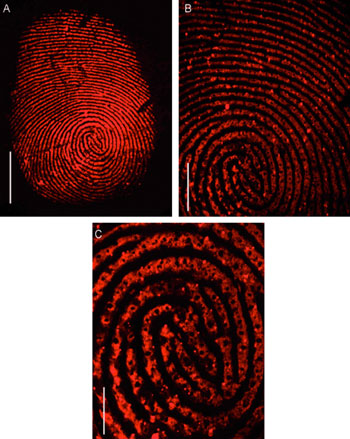
| fluorescence images showing detailed fingerprint information using antibody-functionalized nanoparticles. The images are taken from the thumb of a male smoker after 40 min sweating and illuminated using an Alexa Fluor 546-tagged secondary antibody fragment. Scale bar: 5 mm (A), 2 mm (B), and 1 mm (C). (Reprinted with permission from Elsevier Ltd.) | |
| The review paper, written by Maynard together with Dr. Claude Roux, a Professor of Forensic Science at UTS, Dr. Andrew McDonagh and Dr. Mi Jung Choi, focuses on the applications and limitations of techniques relying on metal-containing nanoparticles and nano-structured particles ("Metal-containing nanoparticles and nano-structured particles in fingermark detection"). | |
| The UTS researchers write that some of these methods are not yet sufficiently mature for routine implementation in casework and that ongoing research is required to continue the development of nanotechnology-based fingermark detection methods to optimize the results obtained from this approach. | |
| The use of nanostructured materials in forensic fingerprint detection is based on the vastly increased ratio of surface area to volume present in many nanomaterials compared to the bulk material (as an illustration, check out question 19 in our Nanotechnology Quiz). In comparison, most of the particles that can be found in powders used in fingerprint detection today are between 1 and 10 micrometers, i.e. up to 1000 times larger than small nanoparticles. | |
| Another advantage of nanoparticles is the effect of certain quantum phenomena that become pronounced at a size scale below 100 nm (e.g. doping properties, interaction with light, electron transport properties) and which could allow the application of novel detection methods by forensic scientists. | |
| The review focuses on metal particles in their elemental state (for example see: Nanotechnology reveals fingerprints), metal oxide particles, and metal sulfide particles and describes the current state-of-the-art research in each area although it cautions that some of these methods are not yet sufficiently mature for routine implementation in casework. | |
| "Nanotechnology has proved to be a promising area of research for forensic fingerprint scientists and it is generally considered that nanotechnology may lead to the development of new materials and reagents with superior characteristics to conventional ones" says Maynard. "Nanotechnology provides new opportunities in surface-based science and because latent fingermark detection can be broadly seen as surface-based phenomena, it is obvious that nanotechnology is a prime candidate to allow completely different approaches to significantly improve detection sensitivity using chemical reagents. | |
 By
Michael
Berger
– Michael is author of three books by the Royal Society of Chemistry:
Nano-Society: Pushing the Boundaries of Technology,
Nanotechnology: The Future is Tiny, and
Nanoengineering: The Skills and Tools Making Technology Invisible
Copyright ©
Nanowerk LLC
By
Michael
Berger
– Michael is author of three books by the Royal Society of Chemistry:
Nano-Society: Pushing the Boundaries of Technology,
Nanotechnology: The Future is Tiny, and
Nanoengineering: The Skills and Tools Making Technology Invisible
Copyright ©
Nanowerk LLC
|
|
|
Become a Spotlight guest author! Join our large and growing group of guest contributors. Have you just published a scientific paper or have other exciting developments to share with the nanotechnology community? Here is how to publish on nanowerk.com. |
|
