
| Posted: Aug 11, 2008 | |
Nanoscale self-assembly with 'molecular glue' |
|
| (Nanowerk Spotlight) The key to using self-assembly as a controlled and directed nanofabrication process lies in designing the components that are required to self-assemble into desired patterns and functions. Self-assembly reflects information coded in individual components – characteristics such as shape, surface properties, charge, polarizability, magnetic dipole, mass, etc. These characteristics determine the interactions among the components and the whole essence of self-assembly arises from these dynamic properties. | |
| In this respect, many self-assembled nanostructures show to be responsive to external stimuli such as temperature, pH, or solvent polarity. An exciting field for nanotechnology researchers is the challenge of extending the scope of nanostructures with stimulus-responsive properties towards the fabrication of 'smart' nanoscale materials. | |
| New work by Korean scientists demonstrates that simple addition of small guest molecules triggers reversible structural transformation. The novelty of this research is that, so far, switching of material properties triggered by external stimuli via nanoscale objects had not been realized yet. | |
| "We have demonstrated that one-dimensional (1D) cylindrical nanofibers formed by self-assembly of rationally designed molecules can associate laterally into two-dimensional (2D) ribbons triggered by aromatic guest molecules that act as a molecular glue" Dr. Myongsoo Lee tells Nanowerk. "Furthermore, this reversible association leads to a macroscopic switching of bulk solutions from gel to fluid states. Compared to other self-assembled 1D systems, it is remarkable that our cylindrical fibers can be bound with one another in a lateral way by glue action of the guest molecules to form larger 2D aggregates. In general, supramolecular systems involving multiple assembling modules are hard to control." | |
| These results represent a significant example of dynamic structural variation triggered by external stimuli in a self-assembling system, thus providing a useful strategy to create intelligent nanoscale materials with predefined functions. | |
| Lee, who heads the Center for Supramolecular Nano-Assembly at Yonsei University in Seoul, together with two of his graduate students, Eunji Lee and Jung-Keun Kim, published his findings in the July 10, 2008 online edition of Angewandte Chemie International ("Lateral Association of Cylindrical Nanofibers into Flat Ribbons Triggered by 'Molecular Glue'"). | |
| In previous work ("Nanofibers with Tunable Stiffness from Self-Assembly of an Amphiphilic Wedge-Coil Molecule"), Lee's group has demonstrated formation of cylindrical micelles from the self-assembly of a wedge-coil block molecule, and reversible switching between rigid rodlike aggregates and flexible coil-like aggregates triggered by a change in solvent polarity. | |
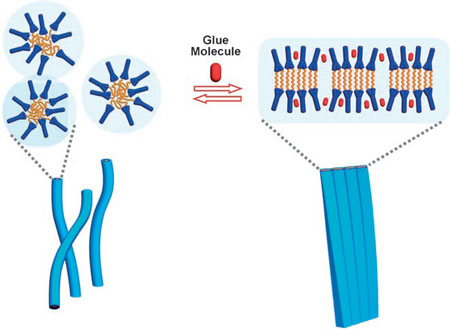
| "In particular, the formation of flexible coil-like cylindrical aggregates in aqueous solution is attributed to the aggregation of branched hydrophobic chains into amorphous cylindrical cores" explains Lee. "Thus, the addition of aromatic guest molecules into the hydrophobic core should force the Y-shaped aromatic segments, which are radially distributed, to be arranged in a more dense, parallel packing and so bind the guest efficiently." | |
 |
|
| Schematic representation of the transformation of single nanofibers to flat ribbons driven by 'molecular glue'. (Reprinted with permission from Wiley) | |
| Lee points out that this rearrangement could result in a structural change of the 1D assembly into larger aggregates to maximize the parallel packing of the aromatic segments – "the guest molecules could then be considered as 'molecular glue' because they stick individual aromatic segments to one another, which subsequently leads to the formation of larger aggregates." | |
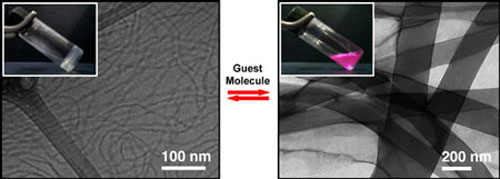
| To corroborate the structural change upon addition of the guest molecule, Lee's team carried out transmission electron microscopy on a solution containing Nile Red. "The micrograph of the unstained sample revealed ribbonlike aggregates with lengths of up to several micrometers" says Lee. "Close examination of the samples revealed that the flat ribbons consist of laterally stacked elementary fibers. The density profile perpendicular to the long axis of the ribbon showed an interfiber distance of about 18 nm, which is consistent with the diameter of the single fibers. This finding indicates that the cylindrical fibers are laterally associated into flat ribbons on addition of the aromatic guest." | |
 |
|
| TEM images and photographs (inset) showing?a gel?(left)?and?fluid solution?(right) (Image: Dr. Lee, Yonsei University) | |
| Since this structural transformation occurs in aqueous solution, it opens interesting perspectives of novel strategies to create intelligent nanoscale materials with predefined functions for nanomedicine, i.e. of applying reversible sol-gel transition for target-selective drug delivery vehicles. | |
 By
Michael
Berger
– Michael is author of three books by the Royal Society of Chemistry:
Nano-Society: Pushing the Boundaries of Technology,
Nanotechnology: The Future is Tiny, and
Nanoengineering: The Skills and Tools Making Technology Invisible
Copyright ©
Nanowerk LLC
By
Michael
Berger
– Michael is author of three books by the Royal Society of Chemistry:
Nano-Society: Pushing the Boundaries of Technology,
Nanotechnology: The Future is Tiny, and
Nanoengineering: The Skills and Tools Making Technology Invisible
Copyright ©
Nanowerk LLC
|
Become a Spotlight guest author! Join our large and growing group of guest contributors. Have you just published a scientific paper or have other exciting developments to share with the nanotechnology community? Here is how to publish on nanowerk.com.