| Posted: Sep 23, 2008 | |
Playing nanotechnology pinball in the atomic cafe |
|
| (Nanowerk Spotlight) The concept of a 'machine' – a mechanical or electrical device that transmits or modifies energy to perform a certain task – can be extended to the nano-world. On the nanoscale, the nanomachine components would be atomic or molecular structures each designed to perform a specific task which, all taken together, would result in a complex function. However, these nanomachines can not be built by just further miniaturizing machine blueprints from the macro-world. Computer chips are such an example, where quantum size and coherence effects, high electric fields creating avalanche dielectric breakdowns, heat dissipation problems in closely packed structures and the relevance of single atom defects all present roadblocks along the current road of miniaturization. | |
| Functional nanomachinery will need to take into account the quantum effects that dominate the behavior of matter at the nanoscale, affecting the optical, electrical and magnetic behavior of materials. | |
| Scientists in The Netherlands are now reporting how an atomic scale mechanical device consisting of two moving parts, each composed of only two atoms can be controlled by an external electrical signal, while being stable and providing a variety of functional modes. They jokingly refer to it as playing atomic pinball, since the two moving parts resemble the flippers in a pinball machine – unfortunately they haven't got a ball yet to play with. | |
| "We have demonstrated the stimulated and controllable mobility of an atomic scale mechanical device" Dr. Harold J.W. Zandvliet tells Nanowerk. "This atomic scale variant of pinball machine flippers exhibits a variety of dynamic modes that are exclusively excited by an external electrical signal. Our work is an important advance in atomic-scale engineering since it shows that even on the scale of a few atoms, a device can be constructed that only operates if an external stimulus is applied." | |
| Zandvliet, a professor at the MESA+ Institute for Nanotechnology, University of Twente in the Netherlands, together with his team, discovered this atomic pinball machine by accident since they didn't set out to design or assemble a NEMS device. | |
| "Our initial aim was to study the physical properties of self-organizing dimerized atomic chains" explains Zandvliet. "Such one-dimensional systems can exhibit a myriad of exotic physical properties such as a Peierls instability, quantization of conductance and Luttinger liquid behavior." | |
 |
|
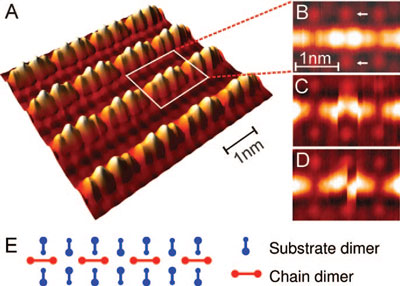
| An STM topograph of atomic chains on Ge(001) at 4.7 K, gap voltage -1.5 V and tunneling current 0.5 nA. Bright protrusions are the atoms that make up the atomic width chains in the image. As a result of a Peierls instability the chains exhibit a 4-fold periodicity with dimers paired together, giving a periodic low-high-high-low appearance of the atoms in the chains. (B) Top view of a regular dimer pair at 77 K, gap voltage -1.0 V and tunneling current 0.8 nA. Two terrace atoms can be seen to protrude from the Ge(001) surface indicated by the white arrows. (C,D) Two subsequent images of a dimer pair that exhibits mobility. The reconfiguration of the dimer pairs is too fast to image and shows up as a discontinuity as the tip is scanned across the chain. (E) Schematic diagram of the dimerized atomic chain and the underlying substrate. (Reprinted with permission from American Chemical Society) | |
| The elementary building block of the structure that the Dutch researchers have studied is a pair of platinum atoms, referred to as a dimer, on a germanium surface. | |
| Zandvliet explains that, in contrast to an individual atom, a dimer can exhibit a rotational mode, too, that leads to additional distinguishable and often energetically equivalent configurations. | |
| "While our initial experiments did not provide any evidence for dynamic behavior of the dimer pairs, we came across one select case where the atomic structure of a dimer pair deviated from the periodic structure that is observed elsewhere in the chains" he says. "In this special case, the two center atoms of the dimer pair rearranged frequently while the scanning tunneling microscope (STM) tip was scanning across the chain." | |
| After closer examination, the team found that one atom in the pair acts as a pivot while the other swings back and forth, like the flipper in a pinball machine. But they did this only when they were exposed to the electrons from the STM. Increasing the strength of the current increased the flipping frequency. | |
 |
|
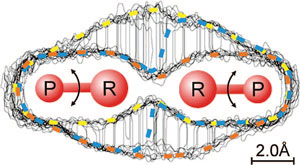
| The boundaries of the dimer pair at 87% maximum height measured from STM topographs. The narrow lines designate the measured boundary positions. The atoms of the dimer pairs are identified as pivot atoms (P) or revolving atoms (R). The motion of the dimers, indicated by the red arrows, resembles that of the flippers of an atomic pinball machine. The thick dashed lines designate a down-down (orange), down-up (blue) and up-up. (Reprinted with permission from American Chemical Society) | |
| Although this experiment nicely demonstrates the feasibility of controlling the mobility of an atomic scale mechanical device, there are several basic questions and issues that need to be resolved before this can be applied to functional machinery. | |
| According to Zandvliet, the two crucial questions that still remain to be answered regarding the mobility of the dimer pair are why the particular dimer configuration that they have investigated here is mobile and how it is structurally different from other dimer pairs in the chains. | |
| "Currently, we are still analyzing the current time traces in detail" he says. "Out of a billion electrons that tunnel between tip and pinball machine only one electron induces a flip-flop event. Our analysis reveals that this one-electron process is fully stochastic." | |
| The scientists believe that the most likely explanation for the flipping dimer is that the substrate atom underneath the two revolving atoms has been replaced by a different atom, leading to a reduced binding of the dimers with the substrate and a sideways displacement of the dimers as they attach to neighboring substrate atoms. | |
| "Unfortunately, it is not possible for STM to identify the chemical nature of this subsurface atom and no other available chemical characterization techniques has the required resolution, meaning that the chemical identification of this atom cannot be performed experimentally" says Zandvliet. | |
| A more practical complication is that, although the current of the STM tip can be used to reliably influence the rate at which the dimer pair switches from one mechanical configuration to another, using an STM is a very complicated way of applying the external signal. It would be much nicer if one could simply apply a voltage to external contacts and subsequently adjust the flipping frequency of the flippers. | |
| The University of Twente team reported their findings in the September 10, 2008 online edition of Nano Letters ("Playing Pinball with Atoms") | |
 By
Michael
Berger
– Michael is author of three books by the Royal Society of Chemistry:
Nano-Society: Pushing the Boundaries of Technology,
Nanotechnology: The Future is Tiny, and
Nanoengineering: The Skills and Tools Making Technology Invisible
Copyright ©
Nanowerk LLC
By
Michael
Berger
– Michael is author of three books by the Royal Society of Chemistry:
Nano-Society: Pushing the Boundaries of Technology,
Nanotechnology: The Future is Tiny, and
Nanoengineering: The Skills and Tools Making Technology Invisible
Copyright ©
Nanowerk LLC
|
|
|
Become a Spotlight guest author! Join our large and growing group of guest contributors. Have you just published a scientific paper or have other exciting developments to share with the nanotechnology community? Here is how to publish on nanowerk.com. |
|
