
| Posted: Sep 18, 2006 | |
Biomechanical nanoswitches open door to green bioelectronics |
|
| (Nanowerk Spotlight) The ability to generate functional nanoswitches might ultimately allow the integration of nanocomponents into electronic components. Single molecule switches using scanning tunneling microscope (STM) manipulation have been demonstrated before. Mostly these switches are based on single atoms or small molecules and operate between two distinct states. Researchers now realized the first multi-step switching process by STM manipulation on a single molecule. Instead of small organic molecules they used a large plant molecule which is environmentally friendly and abundant in nature. | |
| Dr. Saw-Wai Hla and graduate student Violeta Iancu from Ohio University have transformed a molecule of chlorophyll-a into a complex biological switch. Chlorophyll-a is a central molecule in photosynthesis – a process that converts sun light into chemical energy in plant leaves. The conformation changes of this molecule play a vital role in the photosynthesis process. | |
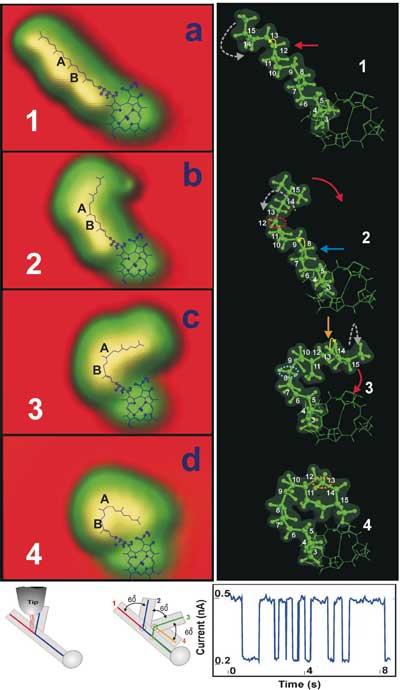
| The scientists used a scanning tunneling microscope to image chlorophyll-a and then injected it with a single electron to manipulate the molecule into four positions, ranging from straight to curved, at varying speeds. Though the Ohio University team and others have created two-step molecule switches using scanning tunneling microscope manipulation in the past, the new experiment yields a more complex multi-step switch on the largest organic molecule to date. | |
 |
|
| Four-step molecular conformation switching. STM images (Left) and calculated structures (Right) using the PM3 method. (a) A straight-tail conformation (1) can be switched into a bent-tail conformation (2; b) by changing the tail angle at A. This switching is caused by a counterclockwise rotation of phytyl-chain at the location shown with a red arrow in the calculated image. Another 60° bending at B in the STM image (Left) changes conformation 2 to conformation 3 (c). This tail-bending is due to the rotation of a part of the phytyl indicated with a blue arrow in the calculated image (Right). Further 60° bent at A changes the conformation 3 to conformation 4 (d). This switching is realized by a clockwise rotation of the phytyl shown with an orange arrow in the calculated image (Right). The STM tip-height profile below is taken along the long molecular axis of chlorophyll-a from a. The height of the molecule remains more or less the same upon switching of the conformation. The cartoons demonstrate the STM tip-induced switching procedure, and the tail bending locations, A and B. (Source: Dr. Hla) | |
| "In our experiments" Hla explains to Nanowerk "we not only were able to image different conformation, but also able to induce and even reversibly switch the conformations of this molecule. Our study provides the mechanical, structural information of this molecule at sub-molecular level. Furthermore, we were able to determine the energy barrier to switch the conformation on Au(111) surface experimentally." | |
| All these points are important for fundamental understanding of this molecule. However, what is most exciting about this research is that Hla and Iancu exploited the controlled changes of four molecular conformations to demonstrate a four-step single molecule switch with atomic scale precision. | |
| "We can also change the switching frequency by changing the tunneling current" says Hla. "Furthermore, we could also explain the underlying mechanism of this switching process as energized by a single tunneling electron energy transfer to the molecule. Experimentally, we managed to determine the energy barrier to switch the conformation of the molecule. | |
| This work opens an entirely new research route to study conformation of larger single biological molecules using STM manipulation with an atomic or sub-molecular control. | |
| Molecular conformations play a critical role in biological functions. Studying different molecular conformation and their mechanical, electronic and structural properties at an atomic scale will be extremely valuable for understanding and consequently, preventing diseases or tailoring of smart medicines. | |
| "For example" says Hla, "one could imagine using this plant molecule switch at a nano or atomic scale circuit junction to build a selector switch or to be used in a nano/atomic scale logic circuit. Other possible applications could be in bioelectronic and medical devices." | |
| An open access article describing these findings "Realization of a four-step molecular switch in scanning tunneling microscope manipulation of single chlorophyll-a molecules" appeared in the September 5, 2006 online edition of PNAS. | |
 By
Michael
Berger
– Michael is author of three books by the Royal Society of Chemistry:
Nano-Society: Pushing the Boundaries of Technology,
Nanotechnology: The Future is Tiny, and
Nanoengineering: The Skills and Tools Making Technology Invisible
Copyright ©
Nanowerk LLC
By
Michael
Berger
– Michael is author of three books by the Royal Society of Chemistry:
Nano-Society: Pushing the Boundaries of Technology,
Nanotechnology: The Future is Tiny, and
Nanoengineering: The Skills and Tools Making Technology Invisible
Copyright ©
Nanowerk LLC
|
Become a Spotlight guest author! Join our large and growing group of guest contributors. Have you just published a scientific paper or have other exciting developments to share with the nanotechnology community? Here is how to publish on nanowerk.com.