
| Posted: Dec 18, 2008 | |
Bio-based nanotechnology materials for a green society |
|
| (Nanowerk Spotlight) Synthetic fibers are ubiquitous in modern society and their manufacture represents a huge, multi-billion dollar worldwide industry. Synthetic fibers – carbon fibers, nylon, polyester, kevlar, spandex, etc. – are manufactured from fossil fuels, usually from oil, but sometimes from coal or natural gas. Most of these materials are not biodegradable and, in addition to their significant carbon footprint during production, they pose environmental problems at the end of their life cycle. | |
| Natural fibers, on the other hand, such as wool and cotton, come from renewable animal or plant sources but they usually lack the high-performance characteristics of many synthetic fibers. This may change, as the new field of bio-based nanomaterials promises to deliver environmentally friendly, high-performance bio-fiber materials that can replace some of the synthetic materials. | |
| Cellulose, which is the most common organic compound on the planet, is a structural component of the cell walls of many plants. Its industrial use is mainly for making paper and cardboard but recently it has also attracted significant interest as a source of biofuel production. Nanotechnology researchers are interested in it because highly-crystalline cellulose nanofibers, abundantly present in natural plant bodies, have unique properties and sizes different from synthetic nanofibers. These scientists believe that cellulose nanofibers have a high potential to be used as transparent and extremely strong films in many different areas. This could lead to environmentally-compatible and high-performance packaging components. | |
| "Because of the presence of numerous hydrogen bonds between cellulose microfibrils in plant cell walls, it has been impossible to convert native cellulose fibers into aqueous dispersions of individual cellulose microfibrils without significant decreases in microfibril length and without impairing their structural potential," Dr. Akira Isogai explains to Nanowerk. "With our newly developed technique, we were able to obtain completely individualized cellulose nanofibers from wood cellulose, 4-5 nm in width and at least a few microns in length." | |
| Isogai, a professor in the Laboratory of Cellulose, Pulp and Paper Science at the Department of Biomaterial Sciences, University of Tokyo, together with his team, have used their cellulose-based nanofibers to fabricate transparent gels and thin films that have remarkably high-oxygen barrier capability (which, according to Isogai, is a really unexpected result), high optical transparency, high strength and a quite low coefficient of thermal expansivity, caused by high crystallinity of native cellulose. | |
| The scientists reported their findings in the December 4, 2008 online edition of Biomacromolecules ("Transparent and High Gas Barrier Films of Cellulose Nanofibers Prepared by TEMPO-Mediated Oxidation"). | |
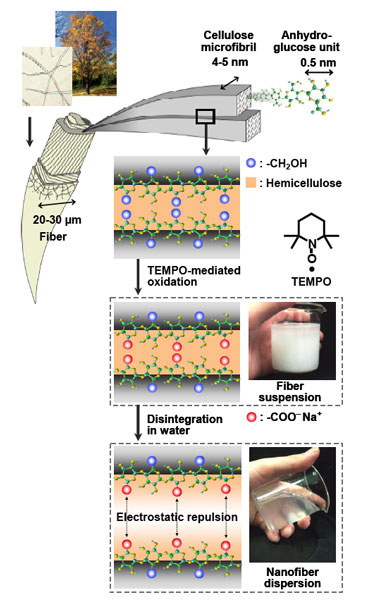
| The technique developed by the Japanese team is based on the selective oxidation of primary hydroxyl groups on the fibril surfaces to anionically-charged carboxylate groups through TEMPO-mediated oxidation of native celluloses and the subsequent mild disintegration in water. The resulting bionanofibers maintained the crystallinity and crystal widths of the original wood celluloses to be about 75% and 3-4 nm, respectively. | |
 |
|
| Systematic diagram of individualization of nano-sized plant cellulose fibrils by direct surface carboxylation using TEMPO catalyst. (Image: Dr. Isogai/University of Tokyo) | |
| Because the TEMPO-oxidized cellulose nanofiber films had quite high oxygen-barrier properties, they are potentially very interesting materials for biodegradable and high-performance packaging components in the pharmaceutical and food industries. | |
| Other candidates to use the new bio-nanofibers are flexible display panel and electric device components (because of the extremely low coefficient of thermal expansion and the high optical transparency), high tensile strengths fiber and film composite materials, and health care components. | |
| A problem that Isogai's team encountered was a gradual degradation of the films' oxygen barrier capability with increasing humidity. Although oxygen permeability of the TEMPO-oxidized cellulose nanofiber films under dry conditions was remarkably low, it became higher when measured at relative humidity of, for example, 90%. Moreover, water vapor permeability of the original films, which is also one of the significant and required properties for packaging components, was insufficient at present because of the hydrophobic nature of the TEMPO-oxidized cellulose nanofibers. | |
| "We are now working on refining our processing, modification and composition methods of the TEMPO-oxidized cellulose nanofibers to add moisture-resistance, high oxygen-barrier properties at high relative humidity, water vapor-barrier properties, and other functional properties necessary for high-tech materials," says Isogai. | |
| A project of the TEMPO-oxidized cellulose nanofibers, supported by the Japanese Government and in cooperation with Nippon Paper Industries and Kao Corporation, has been ongoing since 2007. Its goal is the development of environmentally-compatible and high-performance packaging components. | |
| Isogai mentions that this project, proposed by his group, was selected as the highest ranked of the Nanotech Challenge Program by the New Energy and Industrial Technology Development Organization of Japan. | |
 By
Michael
Berger
– Michael is author of three books by the Royal Society of Chemistry:
Nano-Society: Pushing the Boundaries of Technology,
Nanotechnology: The Future is Tiny, and
Nanoengineering: The Skills and Tools Making Technology Invisible
Copyright ©
Nanowerk LLC
By
Michael
Berger
– Michael is author of three books by the Royal Society of Chemistry:
Nano-Society: Pushing the Boundaries of Technology,
Nanotechnology: The Future is Tiny, and
Nanoengineering: The Skills and Tools Making Technology Invisible
Copyright ©
Nanowerk LLC
|
Become a Spotlight guest author! Join our large and growing group of guest contributors. Have you just published a scientific paper or have other exciting developments to share with the nanotechnology community? Here is how to publish on nanowerk.com.