| Posted: Jan 19, 2009 | |
Swallowing a nanotechnology pill |
|
| (Nanowerk Spotlight) Typically, nanoparticles have been used for drug delivery and it is only recently that carbon nanotubes (CNTs) have gained attention as potential drug delivery vehicles (see: "Nanotechnology's magic bullet "). Carbon nanotubes offer a number of advantages which suggest that they may provide an improved result over nanoparticles. They have a larger inner volume which allows more drug molecules to be encapsulated, and this volume is more easily accessible because the end caps can be easily removed, and they have distinct inner and outer surfaces for functionalization. Current research has shown the ability of CNTs to carry a variety of molecules such as drugs, DNA, proteins, peptides, targeting ligands etc. into cells – which makes them suitable candidates for targeted delivery applications. Despite these advantages, a suitable delivery system has not been developed yet for the targeted delivery of CNTs to specific sites. | |
| A research team from various Canadian and U.S. universities has now demonstrated, for the first time, the design and development of a novel microcapsule carbon nanotube targeted delivery device. | |
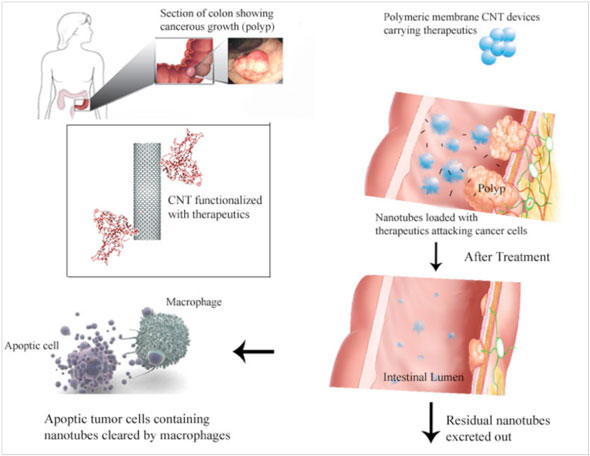
| "Our results have shown that carbon nanotubes functionalized with therapeutic molecules can be embedded into the core or at the surface of different types of alginate capsules to form novel polymeric membrane CNT microcapsules," Satya Prakash tells Nanowerk. "The membrane offers protection to the drug being carried, while the CNTs help achieve targeted delivery of the therapeutic." | |
| As CNTs can be functionalized with drugs and biomarkers specific to a disease, this device can be targeted for a specific site for optimal clinical benefits and it can easily limit the exposure of the drug to healthy tissues of the body to overcome potential drug induced toxic side-effects. | |
| Prakash, an associate professor in biomedical engineering, at McGill University and director of the university's Biomedical Technology and Cell Therapy Research Laboratory, and his collaborators expect their device to have great potential in the delivery of drugs, genes, proteins and other therapeutic molecules. Together with scientists from Rensselaer Polytechnic Institute, Southern Illinois University, and Rice University he has published the team's findings in the January 14, 2009 print edition of Nanotechnology ("Microcapsule carbon nanotube devices for therapeutic applications"). | |
| "There is abundant literature in the area of functionalizing CNTs with a variety of therapeutics" says Prakash. "However, almost all studies so far have been focusing on the systemic delivery of the CNTs. Oral delivery is the most convenient route of administration for therapeutics and also offers the advantage of achieving targeted delivery, specifically for diseases of the gastrointestinal tract. There was a need to combine the advances in carbon nanotube research with those in drug delivery systems. Our study, for the first time, investigates the feasibility of designing a polymeric membrane microcapsule CNT device that can be used in oral delivery applications." | |
 |
|
| Example of a polymeric membrane CNT device in colon targeted delivery applications. (Image: Dr. Prakash, McGill University) | |
| So far, the use of CNTs in oral drug delivery – which is one of the most common and convenient route of therapeutics administrations – has not been possible to achieve. During oral delivery a drug must survive the harsh conditions of the gastrointestinal tract and retain its potency to be effective, and CNTs must be released with their cargo at a specific gastrointestinal site. | |
| The team used single-walled CNTs, which they functionalized with hydrophilic carboxylic acid and hydroxyl groups, and then embedded them in the core of alginate microcapsules or coated them on their surface. By using an automated microencapsulator they were able to obtain highly uniform capsules. | |
| "The nanotubes on the capsule surface can be functionalized with antibodies to promote adhesion of the capsules to specific target sites in vivo, thereby facilitating targeted delivery while the embedded CNTs can be functionalized with suitable biomolecules for drug/gene delivery at the site of adhesion upon degradation of the capsule at the target site," explains Prakash. "The biocompatibility of the nanotubes and the encapsulation materials, which has been already established through various studies, makes it possible to use this device for therapeutic purposes." | |
| A particular challenge for the medical application of carbon nanotubes will be their biocompatibility, something which currently is a considerable area of concern, especially with conflicting reports on their toxicity (see: "Comparing apples with oranges - the problem of nanotubes risk assessment "). Long term toxicity studies will have to be conducted in order to establish the safety of this device. | |
 By
Michael
Berger
– Michael is author of three books by the Royal Society of Chemistry:
Nano-Society: Pushing the Boundaries of Technology,
Nanotechnology: The Future is Tiny, and
Nanoengineering: The Skills and Tools Making Technology Invisible
Copyright ©
Nanowerk LLC
By
Michael
Berger
– Michael is author of three books by the Royal Society of Chemistry:
Nano-Society: Pushing the Boundaries of Technology,
Nanotechnology: The Future is Tiny, and
Nanoengineering: The Skills and Tools Making Technology Invisible
Copyright ©
Nanowerk LLC
|
|
|
Become a Spotlight guest author! Join our large and growing group of guest contributors. Have you just published a scientific paper or have other exciting developments to share with the nanotechnology community? Here is how to publish on nanowerk.com. |
|
