| Posted: Feb 16, 2009 | |
Ultrasonication of nanotubes problematic in some nanomedical applications |
|
| (Nanowerk Spotlight) One of the many application areas that carbon nanotubes (CNTs) are experimented with is as a drug carrier in nanomedicine. Typically, nanoparticles have been used for drug delivery and it is only recently that carbon nanotubes have gained attention as potential drug delivery vehicles. Current research has shown the ability of CNTs to carry a variety of molecules such as drugs, DNA, proteins, peptides, targeting ligands etc. into cells – which makes them suitable candidates for targeted delivery applications (see: "Swallowing a nanotechnology pill"). | |
| Polyethylene glycol (PEG) with molecular weight between 1 and 40 kDa is usually used to coat drug or imaging nanocarriers with the purpose of reducing non-specific interactions with cells and thus increasing the nanocarriers circulation time in vivo. However, when PEG in the form of PL-PEG (adsorbing phospholipid-PEG) has been used to functionalize single-walled CNTs (SWCNTs), the finding were not consistent, sometimes even contradictory. | |
| "Two PEGs of different molecular weights (2000 and 5000) have been used to physically functionalize SWCNTs" Reema Zeineldin tells Nanowerk. "It was found that PEG2000 did not prevent cellular uptake of SWCNTs, whereas PEG5000 most of the times reduced significantly the uptake of SWCNTs and in one case it did not. This motivated us to examine if the preparation method of PL-PEG functionalized SWCNTs affected the integrity of PEG." | |
| Zeineldin, an assistant professor of pharmacy at the University of New Mexico's (UNM) College of Pharmacy, is first author of a recent paper in Nano Letters that shows that the integrity of PEG is important to promoting specific cellular uptake of ligand-functionalized SWCNTs (Role of Polyethylene Glycol Integrity in Specific Receptor Targeting of Carbon Nanotubes to Cancer Cells). | |
 |
|
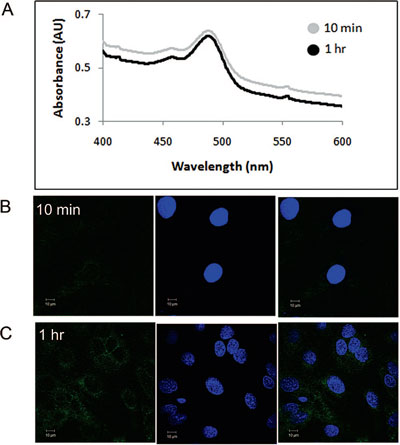
| Fragmentation of PL-PEG2000 by ultrasonication prevents its ability to block nonspecific uptake of SWCNT's by SKOV-3 cancer cells. (A) Absorbance spectrum of SWCNTs functionalized with PL-PEG2000-fluor by ultrasonication for 10 min (gray trace) or 1 hour (black trace) after removing excess PLPEG. (B,C) Confocal microscopy images for SKOV-3 cancer cells after incubating for 24 hours with SWCNTs that were functionalized by PL-PEG2000-fluor via ultrasonication for either 10 min (B) or 1 hour (C). Blue represents DAPI (4',6-diamidino-2-phenylindole) staining for nucleus. Green is fluorescein on PL-PEG-fluorescein-functionalized SWCNTs The scale bar ) 10 µm. (Reprinted with permission from American Chemical Society) | |
| "We found that ultrasonication of PL-PEG with SWCNTs for one hour fragments them, which interfered with their ability to reduce non-specific cellular uptake of SWCNTs," says Zeineldin. "On the other hand, when PL-PEG on SWCNTs was intact, it significantly reduced the uptake of SWCNTs, and further functionalizations with a targeting ligand such as folic acid or epidermal growth factor receptor promoted specific uptake by cells expressing receptors for these ligands." | |
| Ultrasonication in the presence of PL-PEG is a common method used to disperse or functionalize carbon nanotubes and the integrity of PEG is important to promoting specific cellular uptake of ligand-functionalized nanotubes. Blocking nonspecific internalization is achieved only if PEG is not fragmented, which is important for effective targeting of disease cells by SWCNTs while being used for drug delivery. | |
| While there has been some concern about the effect of dispersion by ultrasonication on some of the polymers or biomolecules used in the process to functionalize carbon nanotubes, this issue previously has not been addressed.The findings now demonstrated by the UNM team strongly suggest that ultrasonication of SWCNTs with PL-PEG should be avoided as that fragments PL-PEG. Zeineldin says that, instead, PL-PEG should be either ultrasonicated with SWCNTs for a short time or chemically conjugated to SWNT without ultrasonication. | |
| This work should be of interest to other research aiming at promoting specific targeting of cancer cells by carbon nanotubes through cancer specific receptors for the purpose of imaging or drug delivery since it demonstrates the importance of ensuring the integrity of PEG and other molecules on carbon nanotubes. | |
 By
Michael
Berger
– Michael is author of three books by the Royal Society of Chemistry:
Nano-Society: Pushing the Boundaries of Technology,
Nanotechnology: The Future is Tiny, and
Nanoengineering: The Skills and Tools Making Technology Invisible
Copyright ©
Nanowerk LLC
By
Michael
Berger
– Michael is author of three books by the Royal Society of Chemistry:
Nano-Society: Pushing the Boundaries of Technology,
Nanotechnology: The Future is Tiny, and
Nanoengineering: The Skills and Tools Making Technology Invisible
Copyright ©
Nanowerk LLC
|
|
|
Become a Spotlight guest author! Join our large and growing group of guest contributors. Have you just published a scientific paper or have other exciting developments to share with the nanotechnology community? Here is how to publish on nanowerk.com. |
|
