| Posted: Mar 18, 2009 | |
Biologically active coatings significantly improve implants |
|
| (Nanowerk Spotlight) Ever since doctors started replacing worn or damaged bones and teeth with plastic, metal, or ceramic parts, scientists have been on a quest to develop the perfect material for these orthopedic and dental implants. Initially, the challenge was to overcome the body's response to foreign materials, i.e. the strong tendency to reject them. While a lot of progress has been made, and millions of patients receive implants every year ranging from teeth to hip joints, medical implants still do not achieve the same fit and stability as the original tissue that they replace. | |
| Researchers have found that the response of host organisms (including at the protein and cellular level) to nanomaterials is different than that observed to conventional materials and that nanopatterning of the surface of implant materials therefore leads to much more compatible prostheses (see: Improved nanotechnology implants through nanopatterned metal surfaces). | |
| One approach to improving the biological performance of implants is by functionalizing a non-physiological metallic implant surface through the application of biologically active coatings. Researchers in The Netherlands are now proposing a simple and cost-effective alternative to traditional biomedical coatings for bone implants. | |
| "We found that the enzyme alkaline phosphatase (ALP) can be used to produce novel biomedical implant coatings using a very simple one-step procedure," Lise T. de Jonge tells Nanowerk. "By triggering enzymatically controlled bone mineralization pathways, the ALP-coated implants stimulate mineralization at the interface of implant materials. In this way, an early and strong fixation of bone implants might be realized with significant clinical impact." | |
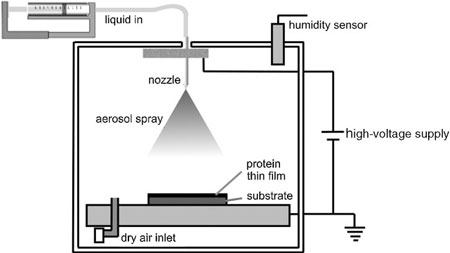
| De Jonge, a PhD student in the Department of Biomaterials at Radboud University Nijmegen Medical Center, is first author of a recent paper in Advanced Functional Materials that investigates the feasibility of the electrospray deposition technique (ESD) to apply homogeneous, biologically active coatings onto implant surfaces ("Electrosprayed Enzyme Coatings as Bioinspired Alternatives to Bioceramic Coatings for Orthopedic and Oral Implants"). | |
 |
|
| Experimental set-up of electrospray deposition (ESD) technique. (Reprinted with permission from Wiley-VCH Verlag) | |
| Led by professor John Jansen, the Dutch team used the ESD technique for the deposition of ALP onto titanium substrates – due to its excellent biocompatibility, titanium is a much used implant material – which were subsequently tested in vitro according to both established and novel soaking procedures. | |
| "Until now, ALP was mainly of interest for tissue engineering purposes to predict neo-tissue mineralization by means of the enzyme expression" says de Jonge. "In our study, though,we propose the use of ALP for enzyme-mediated mineralization as a novel strategy for implant surface modification." | |
| She explains that physicochemical approaches, including calcium phosphate (CaP) ceramic coatings, have been investigated extensively because of their close resemblance to the inorganic component of bone and teeth, which are unique in their ability to form a tight, chemical bond between the synthetic CaP implant surface and surrounding osseous tissue. | |
| "We were able to show that the ALP coatings investigated in this study trigger early, enzymatically controlled stages of mineralization that are not stimulated by conventional, bioceramic CaP coatings which only act on later, physicochemical mineralization processes" de Jonge points out. | |
| Although organic, bone-inducing agents (e.g. members of the transforming growth factor-β super family) have been immobilized onto implant surfaces to affect active bone formation, these agents are extremely expensive and associated with immunological risks. It therefore appears that the cost-effective, bioinspired ALP coatings developed by the Dutch team have great potential as an alternative for conventional ceramic and/or growth factor based coatings. | |
| Despite the rapidly transforming and expanding field of biomaterials, the significant promise of regenerative medicine has not yet resulted in large-scale translation of basic science into novel and revolutionary clinical concepts. De Jonge says that interdisciplinary communication between previously unconnected fields of basic and applied research will become the major challenge within the next decade. "Interaction between biomaterials scientists, clinicians, and developmental/system biologists should be stimulated in order to enable a fully integrated approach towards biomaterials design and pave the way for a future generation of bioinspired biomaterials." | |
| The team has already continued its work and gone beyond the results of purely ALP coatings that they published in the above-mentioned paper in Advanced Functional Materials. In follow-up studies, they evaluated the feasibility of deposited organic-inorganic composite coatings for improved bone response (data not published yet). | |
| "This composite approach is based on the realization that a single material class does not reflect the complexity of highly structured human tissues, and necessitates the use of advanced biomimetic processing techniques to create intelligent biomaterials of similar (nano)functionality" explains de Jonge. | |
 By
Michael
Berger
– Michael is author of three books by the Royal Society of Chemistry:
Nano-Society: Pushing the Boundaries of Technology,
Nanotechnology: The Future is Tiny, and
Nanoengineering: The Skills and Tools Making Technology Invisible
Copyright ©
Nanowerk LLC
By
Michael
Berger
– Michael is author of three books by the Royal Society of Chemistry:
Nano-Society: Pushing the Boundaries of Technology,
Nanotechnology: The Future is Tiny, and
Nanoengineering: The Skills and Tools Making Technology Invisible
Copyright ©
Nanowerk LLC
|
|
|
Become a Spotlight guest author! Join our large and growing group of guest contributors. Have you just published a scientific paper or have other exciting developments to share with the nanotechnology community? Here is how to publish on nanowerk.com. |
|
