

The Magic Egg Bottle: Air Pressure Science Demonstration
Time needed: 5-10 minutes
Difficulty level: Medium
Age range: 10+ years
Adult supervision: Required (involves fire)
Difficulty level: Medium
Age range: 10+ years
Adult supervision: Required (involves fire)
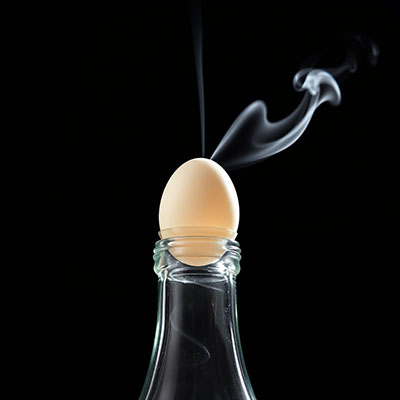
What You'll Learn
Watch as air pressure forces a hard-boiled egg into a bottle without touching it! This classic science demonstration shows how changes in air pressure can create powerful forces, helping us understand atmospheric pressure and basic physics principles.
Materials Needed
Materials collected: 0/4
Wide-mouth glass bottle
Hard-boiled, peeled egg
Small piece of newspaper
Matches or lighter
Safety Notes
Adult supervision required when handling fire and matches
Handle glass bottle carefully to prevent breakage
Bottle will get warm during experiment - wait for it to cool before handling
Step-by-Step Instructions
1
Verify that the hard-boiled egg is slightly larger than the bottle opening
Lightly wet both the egg and the inside of the bottle neck
2
Light the small piece of newspaper on fire
Quickly drop the burning paper into the bottle
3
Immediately place the egg on top of the bottle opening
Watch as the egg gets pushed into the bottle
4
To remove the egg, tilt the bottle and blow hard into it
The increased air pressure will push the egg back out
Watch It In Action
Watch this fascinating demonstration of air pressure at work. Notice how the egg vibrates as the heated air escapes around it, and how it gets smoothly pushed into the bottle by atmospheric pressure.
The Science Behind It
The burning paper heats the air inside the bottle, causing it to expand and rush out past the egg.
As the heated air cools, it creates lower pressure inside the bottle than outside.
The higher air pressure outside pushes the egg into the bottle to equalize the pressure difference.
To get the egg out, blowing into the bottle increases the internal air pressure. The air gets trapped behind the egg like a valve, building up pressure until it forces the egg back out.
Common Questions
Why does the egg get pushed into the bottle?
The difference in air pressure inside and outside the bottle creates a force strong enough to push the egg through the opening. The outside air pressure is greater than the pressure inside the cooled bottle.
Why do we need to wet the egg and bottle?
The water helps create a better seal between the egg and bottle opening, and makes it easier for the egg to slide through.
What if the egg doesn't go in?
Make sure the paper is burning well when you put it in the bottle, the egg is properly peeled and wet, and that you place the egg on the opening immediately after inserting the burning paper.
Why does blowing into the bottle get the egg out?
When you blow into the bottle, the egg acts like a one-way valve. Air gets past it going in but can't escape easily. This builds up pressure behind the egg until there's enough force to push it out - almost like a chicken laying an egg!
What if I can't blow hard enough to get the egg out?
You can try tilting the bottle at different angles to find the best position. The egg needs to be positioned just right for the pressure to push it out effectively. If that doesn't work, you can also try quick puffs of air instead of one long blow.
Take It Further
- Try using different size bottles to see how it affects the experiment
- Measure the temperature of the bottle before and after the paper burns
- Calculate the approximate force needed to push the egg into the bottle
- Experiment with different ways to get the egg out besides blowing
Related Experiments
If you enjoyed this experiment, try these next:
- Bottle Rocket - Explosive fun with air pressure
- Balloon Fermentation - Watch as yeast fermentation inflates a balloon
