| Posted: May 25, 2015 |
Table-top extreme UV laser system heralds imaging at the nanoscale |
| (Nanowerk News) Researchers at Swinburne University of Technology have discovered a new way to generate bright beams of coherent extreme UV radiation using a table-top setup that could be used to produce high resolution images of tiny structures at the nanoscale. “The ability to image nano-scale features with a conventional optical microscope is limited by the wavelength of the light used to illuminate the sample, Professor Lap van Dao, who led the research, said. |
| “One way to achieve higher spatial resolution is to use radiation with shorter wavelengths such as extreme UV radiation or ‘soft’ x-rays.” |
| The new table-top system may offer a cost-effective and convenient alternative to large-scale, multi-million-dollar facilities such as synchrotrons or free-electron lasers, which, until now, were the only way to generate bright coherent beams of extreme UV radiation. |
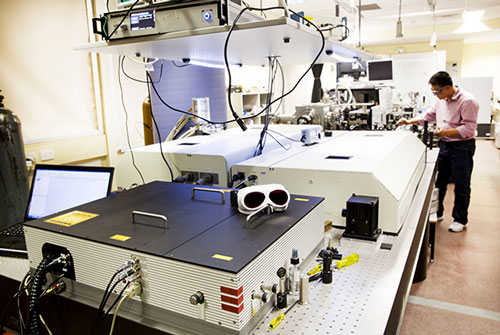 |
| The researchers from the Centre for Quantum and Optical Science used their table-top laser setup to illuminate a gas cell of argon with two intense beams of ultrashort laser pulses at different wavelengths. |
| One beam generates ‘high-order harmonics’ in the extreme UV, while the effect of the second overlapping beam is to amplify the extreme UV radiation by a process known as optical parametric amplification. |
| These bright coherent beams of extreme UV radiation will be used for high resolution imaging based on a ‘lensless’ imaging technique called coherent diffractive imaging, in which images are reconstructed by a computer. |
| “This research paves the way for the generation of intense radiation at still shorter wavelengths and ultimately to apply coherent diffractive imaging techniques to nano-scale structures and to biological samples in the water window region (2-4 nanometres),” Emeritus Professor Peter Hannaford said. |
| The new research has been published in the prestigious journal Nature Communications ("Perturbative optical parametric amplification in the extreme ultraviolet"). |
| Source: Swinburne University of Technology |