| Posted: Nov 12, 2015 |
Light wave technique an advance for optical research(Nanowerk News) RMIT University researchers have developed artificial microflowers that self-assemble in water and mimic the natural blooming process, an important step for advances in frontier-edge electronics. |
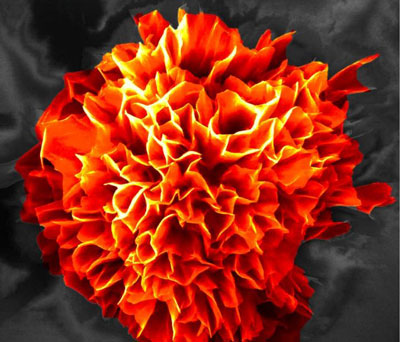 |
| This is a digitally-colored microflower magnified 20,000 times. (Image: RMIT University) |
| Flower-shaped structures have been the focus of research because their distinctive surfaces offer exciting potential for applications in a range of fields - from optoelectronics and chemosensors to nanotechnology, biotechnology, biomedicine and organic electronics. |
| The team from the RMIT-Indian Institute of Chemical Technology Research Centre has for the first time developed microstructures shaped like flowers that build through self-repeating arrangement in water. |
| Lead investigator Dr Sheshanath Boshanale said the field of organic flower-shaped morphology was still in its infancy. |
| "This is the first time flower-shaped microforms have been developed in a water solution, opening an exciting new pathway for further research," he said. |
| "The artificial blooms developed by our team are just 10 microns wide - about 10 could fit along the width of a strand of human hair. |
| "While tiny, they have potential to make a big impact by enabling researchers to easily and reliably build microflowers and use them to break frontiers in a range of scientific fields." |
| To create the microflowers, researchers mixed two organic components (NDI-bearing phosphonic acid and melamine) in water, which is then evaporated. The artificial microflowers take about three hours to fully develop, mimicking the way natural flowers bloom. |
| The research has been published in Scientific Reports. |
| Source: RMIT University |