| Posted: Jun 20, 2016 |
Researchers find better way to 'herd' electrons in solar fuel devices(Nanowerk News) Researchers at the University of British Columbia and the University of North Carolina at Chapel Hill have discovered a new way to optimize electron transfer in semi-conductors used in solar fuel solutions. |
| The finding, published today in Nature Chemistry ("A Kinetic Pathway for Interfacial Electron Transfer from a Semiconductor to a Molecule"), could have a big impact on devices that convert sunlight into electricity and fuel. |
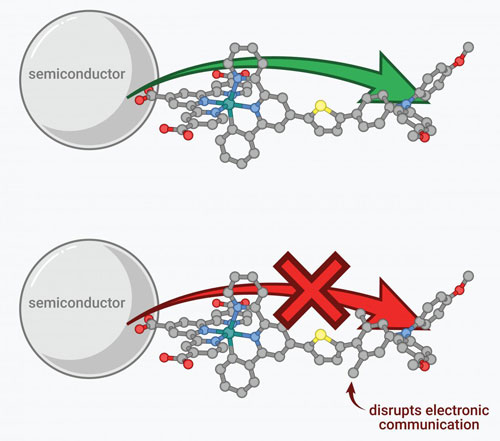 |
| Molecules can be designed to act as a gate and keep electrons moving forward in one direction. (Image: UBC Chemistry) |
| Researchers have already shown that the efficiency of electron transfer at semi-conductor interfaces depends on the distance the electron has to travel. The new finding shows that the efficiency of the transfer also depends on the type of chemical bonds--or the bridge--that the electron travels through along the way. |
| "Now we can design molecules to act as a gate and keep electrons moving forward in one direction and not reverse their direction," says UBC chemist and chemical engineer Curtis Berlinguette, senior author on the paper. |
| "If electrons go in the wrong direction, we lose much of the sun's energy as heat before it can be converted into electricity or fuel." |
| The research also has ramifications in how we view electron transfer in biological systems. |
| Source: University of British Columbia |