| Posted: Aug 25, 2016 |
Graphene under pressure(Nanowerk News) Small balloons made from one-atom-thick material graphene can withstand enormous pressures, much higher than those at the bottom of the deepest ocean, scientists at The University of Manchester report. |
| This is due to graphene’s incredible strength – 200 times stronger than steel. |
| The graphene balloons routinely form when placing graphene on flat substrates and are usually considered a nuisance and therefore ignored. The Manchester researchers, led by Professor Irina Grigorieva, took a closer look at the nano-bubbles and revealed their fascinating properties. |
| These bubbles could be created intentionally to make tiny pressure machines capable of withstanding enormous pressures. This could be a significant step towards rapidly detecting how molecules react under extreme pressure. |
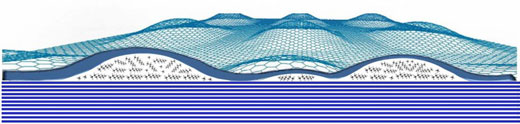 |
| Writing in Nature Communications ("Universal shape and pressure inside bubbles appearing in van der Waals Heterostructures,"), the scientists found that the shape and dimensions of the nano-bubbles provide straightforward information about both graphene’s elastic strength and its interaction with the underlying substrate. |
| The researchers found such balloons can also be created with other two-dimensional crystals such as single layers of molybdenum disulfide (MoS2) or boron nitride. |
| They were able to directly measure the pressure exerted by graphene on a material trapped inside the balloons, or vice versa. |
| To do this, the team indented bubbles made by graphene, monolayer MoS2 and monolayer boron nitride using a tip of an atomic force microscope and measured the force that was necessary to make a dent of a certain size. |
| These measurements revealed that graphene enclosing bubbles of a micron size creates pressures as high as 200 megapascals, or 2,000 atmospheres. Even higher pressures are expected for smaller bubbles. |
| Ekaterina Khestanova, a PhD student who carried out the experiments, said: “Such pressures are enough to modify the properties of a material trapped inside the bubbles and, for example, can force crystallization of a liquid well above its normal freezing temperature’. |
| Sir Andre Geim, a co-author of the paper, added: “Those balloons are ubiquitous. One can now start thinking about creating them intentionally to change enclosed materials or study the properties of atomically thin membranes under high strain and pressure.” |
| Source: University of Manchester |