| Aug 13, 2018 |
New technology can detect hundreds of proteins in a single sample(Nanowerk News) New technology developed by a team of McGill University scientists shows potential to streamline the analysis of proteins, offering a quick, high volume and cost-effective tool to hospitals and research labs alike. |
| Proteins found in blood provide scientists and clinicians with key information on our health. These biological markers can determine if a chest pain is caused by a cardiac event or if a patient has cancer. |
| Unfortunately, the tools used to detect such proteins haven't evolved much over the past 50 years - despite there being over 20,000 proteins in our body, the vast majority of protein tests run today target only a single protein at-a-time. |
| Now, PhD candidate Milad Dagher, Professor David Juncker and colleagues in McGill's Department of Biomedical Engineering have devised a technique that can detect hundreds of proteins with a single blood sample. |
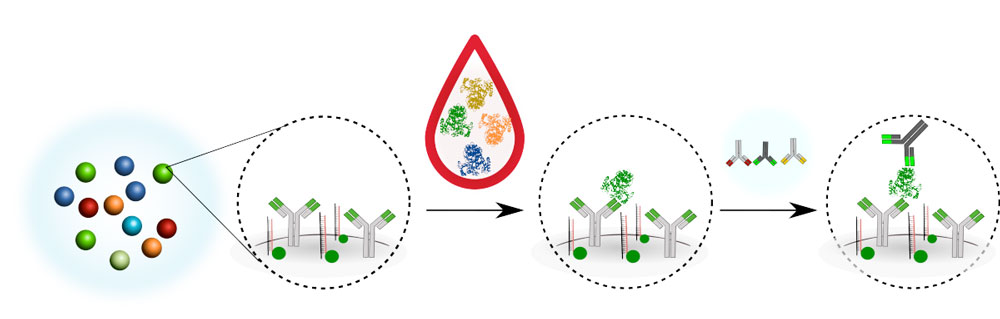 |
| Part of their work, just published in Nature Nanotechnology ("Ensemble multicolour FRET model enables barcoding at extreme FRET levels"), describes a new and improved way to barcode micro-beads using multicolour fluorescent dyes. By generating upwards of 500 differently coloured micro-beads, their new barcoding platform enables detection of markers in parallel from the same solution--for example, a blue barcode can be used to detect marker 1, while a red barcode can detect marker 2, and so on. A laser-based instrument called a cytometer then counts the proteins that stick to the different coloured beads. |
| Though this kind of analysis method has been available for some time, interference among multicolour dyes has limited the ability to generate the right colours. Now, a new algorithm developed by the team enables different colours of micro-beads to be generated with high accuracy--much like a colour wheel can be used to predict the outcome of colour mixing. |
| Professor Juncker's team is hoping to leverage its platform for improved analysis of proteins. |
| "Current technologies hold a major trade-off between the number of proteins that can be measured at once, and the cost and accuracy of a test", Dagher explains. "This means that large-scale studies, such as clinical trials, are underpowered because they tend to fall back on tried-and-true platforms with limited capabilities." |
| Their upcoming work focuses on maintaining accurate detection of proteins with increased scale. |
| Source: McGill University |
|
Subscribe to a free copy of one of our daily Nanowerk Newsletter Email Digests with a compilation of all of the day's news. |