| Dec 20, 2011 |
Terahertz pulse increases electron density 1,000-fold |
| (Nanowerk News) Researchers at Kyoto University have announced a breakthrough with broad implications for semiconductor-based devices. The findings, announced in the December 20 issue of the journal Nature Communications ("Extraordinary carrier multiplication gated by a picosecond electric field pulse"), may lead to the development of ultra-high-speed transistors and high-efficiency photovoltaic cells. |
| Working with standard semiconductor material (gallium arsenide, GaAs), the team observed that exposing the sample to a terahertz (1,000 gigahertz) range electric field pulse caused an avalanche of electron-hole pairs (excitons) to burst forth. This single-cycle pulse, lasting merely a picosecond (10^-12 s), resulted in a 1,000-fold increase in exciton density compared with the initial state of the sample. |
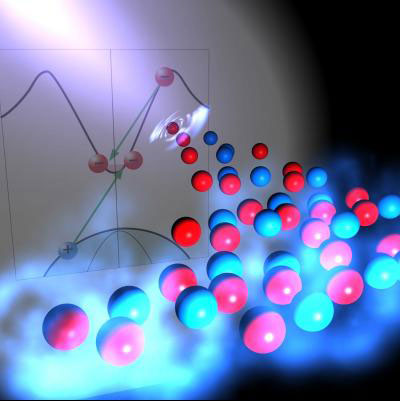 |
| A picosecond terahertz pulse causes an avalanche of excitons to burst forth from semiconductor GaAs. (Image: Courtesy Tanaka Lab, Kyoto University iCeMS) |
| "The terahertz pulse exposes the sample to an intense 1 MV/cm^2 electric field," explains Hideki Hirori, team leader and Assistant Professor at Kyoto University's Institute for Integrated Cell-Material Sciences (iCeMS). "The resulting exciton avalanche can be confirmed by a bright, near-infrared luminescence, demonstrating a three-order of magnitude increase in the number of carriers." |
| Research in Kyoto using terahertz waves is led by Professor Koichiro Tanaka, whose lab at the iCeMS pursues numerous applications including the development of new biological imaging technologies. |
| "Since terahertz waves are sensitive to water, our goal is to create a microscope that will allow us to look inside living cells in real time," says Prof. Tanaka. "These just-released results using semiconductors are an entirely different field of science, but they demonstrate the rich potential that lies in the study of terahertz waves." |
| Source: Institute for Integrated Cell-Material Sciences, Kyoto University |