| Dec 01, 2014 |
Detecting defects in solar cells |
| (Nanowerk News) Solar panels, or photovoltaic (PV) modules, are being rapidly deployed across the world as costs fall and the need for sustainable, low-carbon energy grows. Being able to effectively characterise PV cells is a key factor in quality control during manufacturing and understanding their long-term behaviour. |
| NPL researchers, Simon Hall, Matt Cashmore and John Blackburn, have developed a new technique for efficiently detecting malfunctioning areas of a PV module. |
| Conventional testing involves scanning the PV cells, row by row, with a laser beam and measuring the current generated in response to the light at a series of points. Spatial variations in the cells' performance can then be identified, but the process is time consuming. |
| In the new method, patterns of light are projected onto the PV cells using a digital micromirror device, such as those found in many office projectors. A technique called compressed sensing is then used to make a map of the current generated by the cells in response to the light, in order to identify malfunctioning areas. |
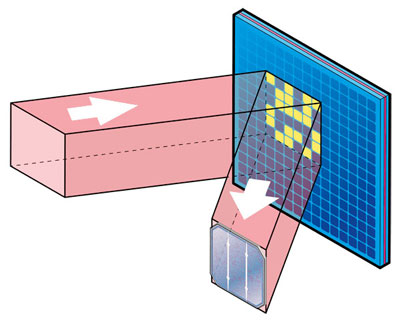 |
| Patterns of light are projected onto PV cells to measure their response. |
| Compressed sensing is a signal processing technique more commonly used to reconstruct images from relatively few pieces of information, through exploitation of the simplicity of real-world images (when compared to, say, an image made up of random pixels). |
| By assuming that defects are sparse, compressed sensing can identify abnormalities in the PV module using fewer measurements than the traditional raster scanning technique, and without the need for moving parts. |
| Several large companies have already shown interest in adopting the technology for a variety of scanning applications. The team at NPL have recently patented the method, and are now undertaking the necessary developments for it to be put into practice. |
| The work was the subject of the winning poster at last month's NPL Science Poster Fair. |
| Source: National Physical Laboratory |