| Aug 08, 2017 |
New battery is activated by your spit |
| (Nanowerk News) Researchers at Binghamton University, State University of New York have developed the next step in microbial fuel cells (MFCs): a battery activated by spit that can be used in extreme conditions where normal batteries don't function (Advanced Materials Technologies, "A Papertronic, On-Demand and Disposable Biobattery: Saliva-Activated Electricity Generation from Lyophilized Exoelectrogens Preinoculated on Paper"). |
| For the last five years, Binghamton University Electrical and Computer Science Assistant Professor Seokheun Choi has focused on developing micro-power sources for the use in resource-limited regions to power point-of-care (POC) diagnostic biosensors; he has created several paper-based bacteria-powered batteries. |
| "On-demand micro-power generation is required especially for point-of-care diagnostic applications in developing countries," said Choi. "Typically, those applications require only several tens of microwatt-level power for several minutes, but commercial batteries or other energy harvesting technologies are too expensive and over-qualified. Also, they pose environmental pollution issues." |
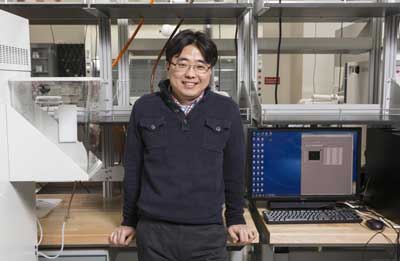 |
| This is Binghamton University Electrical and Computer Science assistant professor Seokheun Choi. |
| Choi, along with research assistant Maedeh Mohammadifar, created a high-performance, paper-based, bacteria-powered battery by building microbial fuel cells with inactive, freeze-dried exoelectrogenic cells which generates power within minutes of adding saliva. The proposed battery generated reliable power from with one drop of saliva, supplying on-board power that could be used by the next generation of disposable, paper-based POC diagnostic platforms. |
| "The proposed battery has competitive advantages over other conventional power solutions because the biological fluid for on-demand battery activation is readily available even in the most resource-constrained settings, and the freeze-drying technology enables long-term storage of cells without degradation or denaturation," wrote the researchers. |
| Choi is focused on improving the batter's power density so that more applications can be powered. |
| "Now, our power density is about a few microwatts per centimeter square. Although 16 microbial fuel cells connected in a series on a single sheet of paper generated desired values of electrical current and voltage to power a light-emitting diode (LED), further power improvement is required for other electronic applications demanding hundreds of milliwatts of energy," said Choi. |
| Source: Binghamton University |