| May 22, 2025 |
On route to mass production of green hydrogen using natural sunlightNew solar tech stably generates high photocurrent for efficient hydrogen production, cutting fabrication time and advancing commercialization of solar hydrogen systems. |
| (Nanowerk News) The Korea Institute of Machinery and Materials (KIMM) has developed a technology that stably generates high photocurrent under natural sunlight to efficiently produce hydrogen. By simplifying previously complex multi-step processes, this advancement drastically reduces fabrication time and is expected to accelerate the commercialization of solar-powered hydrogen production technologies. |
| The findings are published in Journal of Materials Chemistry A ("Breakthrough in the large area photoanode fabrication process: high concentration precursor solution with solvent mixing and one step spin coating for high PEC performance of BiVO4") |
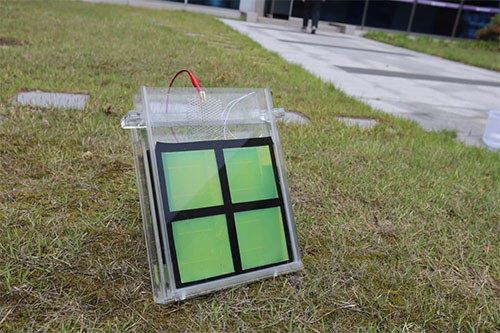 |
| The ultra-large photoelectrode system developed by the research team led by Dr. Jihye Lee at the Nano Lithography Research Center. (Image: KIMM) |
| The research team led by Dr. Jihye Lee, a principal researcher, head of the Nano-lithography & Manufacturing Research Center at KIMM’s Nano-convergence Manufacturing Research Division, has developed a technique to enhance the productivity of BiVO₄ (bismuth vanadate) photoelectrodes, thereby maximizing hydrogen production. BiVO₄ is a metal oxide recognized as a key material for solar water-splitting systems due to its high light absorption and solar-to-hydrogen (STH) conversion efficiency. |
| Previously, BiVO₄ precursor solutions could only be prepared at concentrations up to 100 mM. This limitation necessitated over eight repetitions of spin-coating and heat-treatment steps to form high-performance thin films, which significantly slowed the process and increased material consumption, resulting in low productivity. |
| To overcome these limitations, the research team developed a high-concentration BiVO₄ precursor solution by optimally mixing acetylacetone, acetic acid, and dimethyl sulfoxide (DMSO). With this new solution, a one-step spin coating is sufficient to produce uniform and high-performance BiVO₄ thin films, improving overall productivity by approximately 5.9 times compared to conventional methods. |
| Furthermore, the team fabricated a large-area 144 cm² photoelectrode and connected four of them to create a 576 cm² ultra-large electrode system. Notably, by linking this system in parallel with Si solar cells, they succeeded in producing hydrogen using only natural sunlight, without any external power source. This system generated stable and high photocurrents even under natural sunlight, thus significantly improving the economic viability and efficiency of eco-friendly hydrogen production and enhancing the prospects for commercialization. |
| Dr. Jihye Lee stated, “This research represents a breakthrough in the fabrication efficiency and productivity of large-area photoelectrodes through the development of a high-concentration BiVO₄ precursor solution. We expect it will contribute to accelerating the transition to sustainable energy and the commercialization of green hydrogen production.” |
| Source: Korea Institute of Machinery and Materials (Note: Content may be edited for style and length) |