| Sep 19, 2025 |
Solar-Powered System produces green hydrogen directly from air moistureResearchers developed a solar-powered system that produces green hydrogen directly from atmospheric moisture without relying on external water or energy sources. |
| (Nanowerk News) A team led by Prof. YIN Huajie from the Hefei Institute of Physical Science of the Chinese Academy of Sciences has developed a solar-powered system that produces green hydrogen directly from atmospheric moisture without relying on external water or energy sources. |
| The results were published in Advanced Materials ("Solar‐Driven Atmospheric Water Production Through Hierarchically Ordered Porous Carbon for Self‐Sustaining Green Hydrogen Production"). |
| Proton Exchange Membrane Water Electrolysis (PEMWE) technology is one of the primary routes for producing green hydrogen, drawing significant attention due to its high efficiency and high-purity hydrogen output. However, the PEMWE process heavily relies on high-purity water as the reaction raw material, limiting its application in water-scarce regions. Atmospheric Water Harvesting (AWH), as an emerging approach to obtaining pure water, holds promise as a viable solution to the water shortage issue in the production of green hydrogen. |
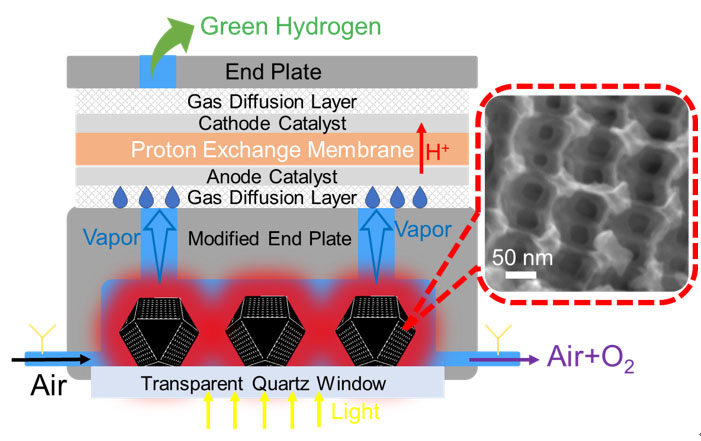 |
| Self-sustaining air water harvesting and proton exchange membrane water electrolysis based on ordered porous carbon. (Image: YIN Huajie) |
| In this study, the researchers developed a self-sustaining system that couples photothermal atmospheric water harvesting with proton exchange membrane electrolysis. |
| The system uses hierarchically porous carbon as an adsorbent to capture moisture from the air, which is evaporated by solar heat and fed into a custom-built electrolyzer for hydrogen production. The porous material is fabricated through template synthesis and calcination, followed by surface oxidation to improve water affinity. |
| It demonstrates remarkable performance. Even under low humidity conditions (as low as 20%), it maintains stable water collection and evaporation performance. Under 40% humidity, the system reached a hydrogen production rate of nearly 300 mL per hour with excellent cycle stability and long-term reliability. |
| Field tests further confirmed that it can continuously produce green hydrogen using only solar energy, with zero carbon emissions and no external energy input. |
| This work provides a new pathway for sustainable hydrogen production in water-scarce regions, according to the team. |
| Source: Hefei Institutes of Physical Science (Note: Content may be edited for style and length) |