| Sep 26, 2025 |
New catalyst turns water pollution into clean ammonia at high efficiency
Researchers developed a catalyst that converts nitrate pollution in water into ammonia with 94.8% efficiency, offering a cleaner alternative to the Haber-Bosch process.
|
|
(Nanowerk News) Producing ammonia is essential for farming, medicine, and many technologies, but the process behind it comes at a huge environmental cost. Today, almost all industrial ammonia is made using the Haber-Bosch process, a method that consumes up to 2% of the world’s total energy and releases significant carbon emissions along the way.
|
|
Now, researchers have developed a cleaner and more energy-efficient alternative that could shift the way ammonia is made. They’ve designed a new catalyst that turns harmful nitrates in water into ammonia—solving two major problems at once: water pollution and energy waste.
|
|
The process focuses on a chemical reaction known as electrocatalytic nitrate reduction. It’s not new, but until now, it’s been too slow and inefficient to replace traditional ammonia production. That changed when the team introduced a layered catalyst made from nickel, copper, and iron.
|
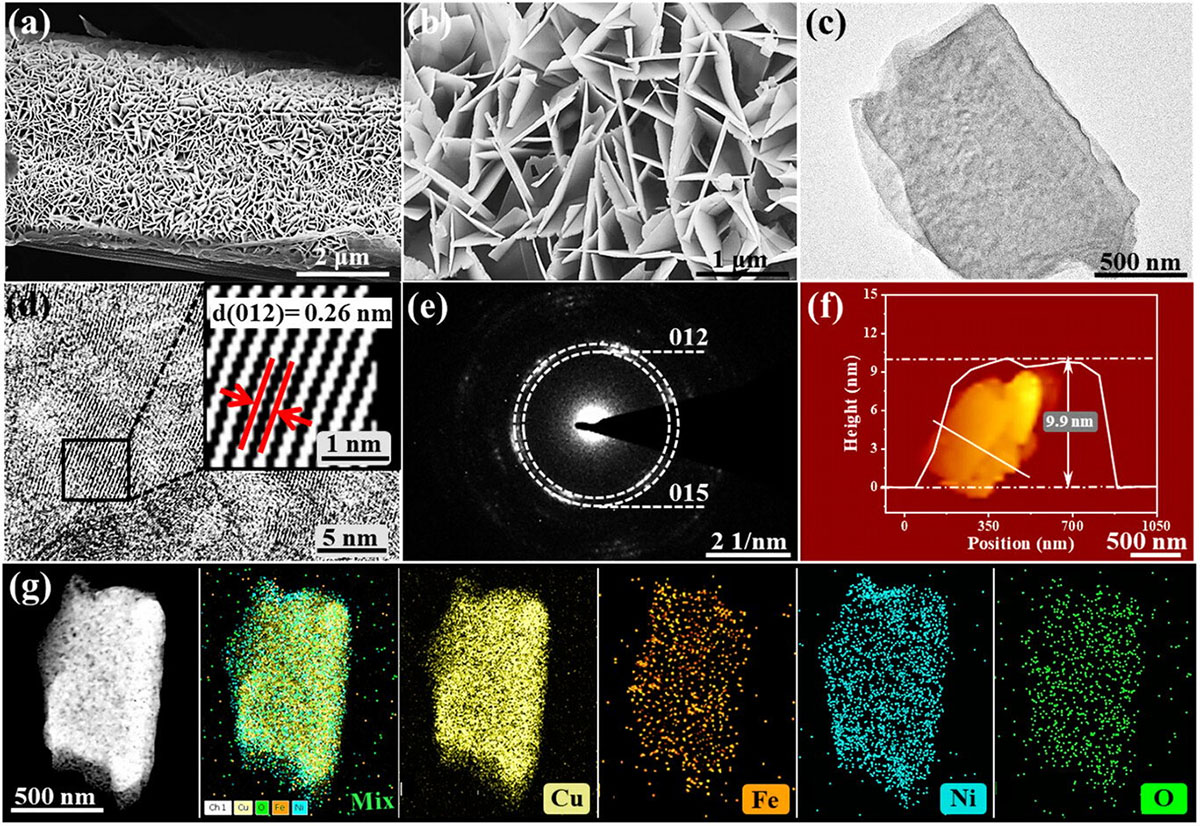 |
| Structural characterization of NiCuFe-LDHs catalyst. a, b) SEM images, c) TEM image, d) HRTEM image, e) SAED pattern, f) AFM profiles, g) HAADF-STEM image, and the corresponding EDS element mapping. The inset in (d) shows the interplanar distance quantified from the HRTEM image. (Image: Reprinted from DOI:10.1002/adfm.202519238, CC BY) (click on image to enlarge)
|
|
“We created NiCuFe-LDH nanosheets with Ni and Cu sites to help with electroreduction,” said Professor Hao Li, who led the study (Advanced Functional Materials, "Modulating Surface‐Active Hydrogen for Facilitating Nitrate‐to‐Ammonia Electroreduction on Layered Double Hydroxides Nanosheets"). “The NitRR went from being too inefficient to even consider, to a Faradaic efficiency of 94.8%.”
|
|
This jump in efficiency means that most of the electricity used in the reaction goes toward making ammonia, not waste. To test the real-world potential of the material, the team also built a zinc–nitrate battery powered by the same catalyst. The results were impressive: it reached an efficiency of 85.8%, produced a large yield of ammonia, and delivered a power density of 12.4 milliwatts per square centimeter—better than most previous results.
|
|
In practical terms, this method could help clean up nitrate-contaminated water while creating a key industrial chemical with far less environmental impact.
|
|
The next step is to test the system on actual wastewater and scale it up to see if it can work in real-world settings. If successful, it could make ammonia production cleaner, cheaper, and more sustainable for a wide range of industries.
|




