| Oct 30, 2025 |
New dual-reaction system doubles output from plant-based chemical process
A new electrochemical system runs two reactions in one cell, converting plant compounds into valuable products with less energy use and higher efficiency.
|
|
(Nanowerk News) Researchers have designed a new electrochemical system that can run two chemical reactions at once, cutting waste and energy use while doubling the output from plant-based feedstocks.
|
|
The team created a “two-in-one” process that turns 5-hydroxymethylfurfural, a compound derived from biomass, into two useful chemicals. One is 2,5-furandicarboxylic acid, used to make renewable plastics. The other is 2,5-dihydroxymethylfuran, a key ingredient for fine chemicals and fuels.
|
|
Usually, these reactions happen separately: oxidation at one electrode and hydrogenation at the other. The new setup combines both inside a single electrolytic cell, working efficiently at room temperature and pressure.
|
|
At the core of the design is a single-atom ruthenium catalyst fixed onto a cobalt hydroxide surface. This atomic structure improves the interaction between electrons and molecules, allowing the two reactions to proceed smoothly and keeping the catalyst stable over long periods.
|
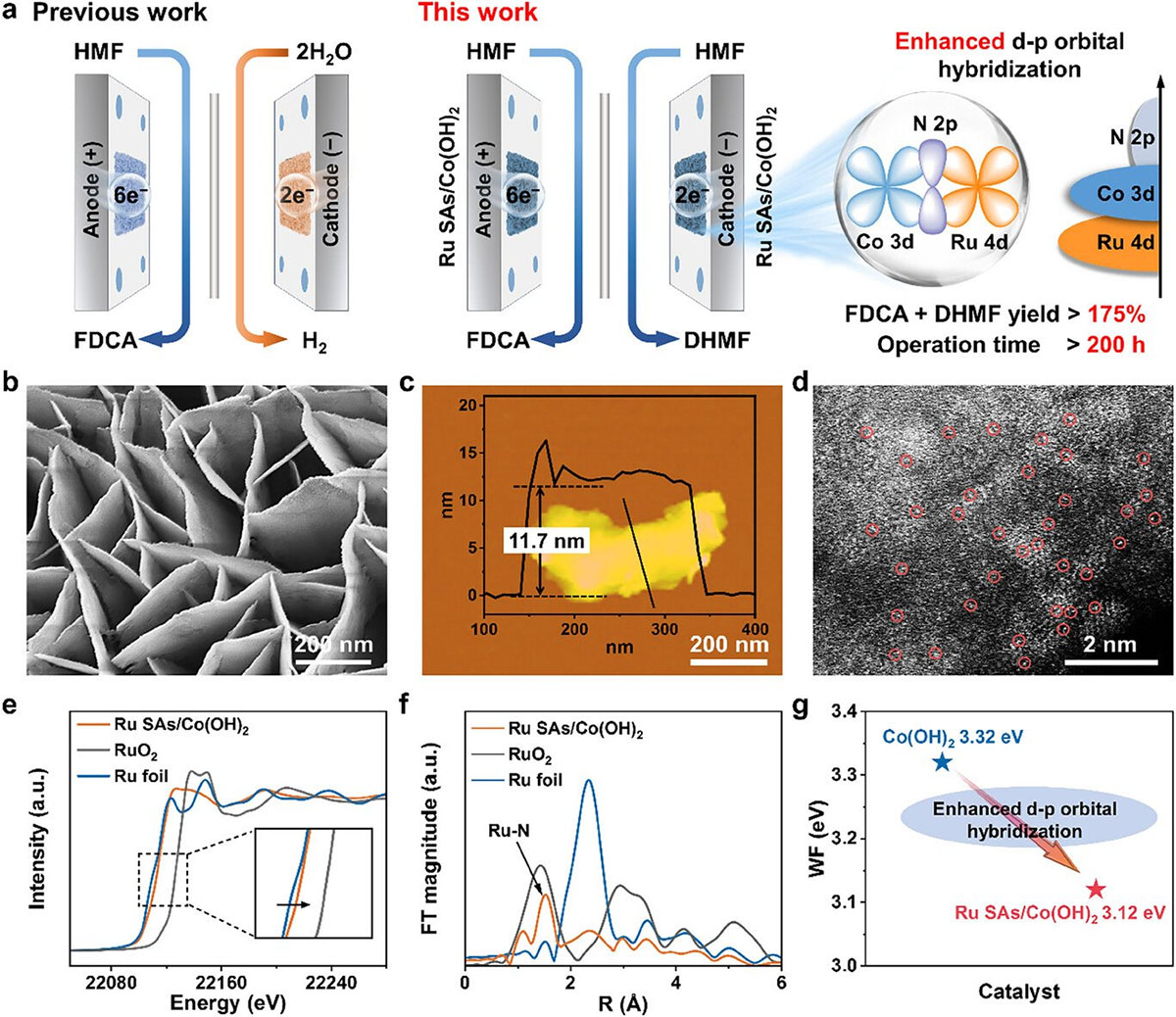 |
| Characterizations of Ru SAs/Co(OH)2. a) Schematic of enhanced d–p orbital hybridization over Ru SAs/Co(OH)2 catalyst. b) SEM, c) AFM and d) AC-HAADF-STEM images of Ru SAs/Co(OH)2 catalyst. e) Normalized XANES of Ru SAs/Co(OH)2 catalyst at the Ru K-edge. Ru foil and RuO2 were used as references. f) FT-EXAFS spectra of Ru in Ru SAs/Co(OH)2 catalyst. g) The obtained work functions of Co(OH)2 and Ru SAs/Co(OH)2 catalysts. (Image: Reprinted from DOI:10.1002/aenm.202504502, CC BY) (click on image to enlarge)
|
|
In continuous testing, the system ran for more than 240 hours without loss of performance. It fully converted the biomass compound into the two target products, achieving a combined yield above 170 percent.
|
|
Economic analysis suggests strong potential for scaling up: each ton of renewable plastic precursor could generate about 5,800 U.S. dollars in revenue.
|
|
“This research is a bit like turning a traditional single-lane road into a two-way street,” said Hao Li, who led the study (Advanced Energy Materials, "Simultaneous Electrocatalytic Oxidation and Hydrogenation of Biomass‐Derived Aldehydes on Single‐Atom Ru Catalysts"). “Instead of separating the oxidation and hydrogenation processes, we let them flow together efficiently in one system. It’s a step toward smarter and more sustainable ways of producing chemicals from renewable resources.”
|
|
The team now plans to test larger reactor systems and improve the way the products are separated to make the process more sustainable. They will also perform a full life cycle assessment to measure environmental and economic performance.
|
|
The study demonstrates how combining efficiency and simplicity in one system can advance sustainable chemical manufacturing powered by renewable feedstocks and clean electricity.
|