| Mar 11, 2026 |
Light management strategies for higher efficiency all perovskite tandem solar cells
A comprehensive review examines optical loss reduction and photon utilization strategies that could push all perovskite tandem solar cells toward their 45 percent efficiency limit.
|
|
(Nanowerk News) A new review published in Light: Science & Applications ("Light management in monolithic all-perovskite tandem solar cells") examines how advanced optical engineering can push monolithic perovskite tandem solar cells closer to their theoretical efficiency ceiling of 45 percent. The study, authored by Assistant Professor Renxing Lin and Professor Hairen Tan of the College of Engineering and Applied Sciences at Nanjing University, provides a systematic framework for understanding and addressing the photon losses that currently constrain device performance.
|
Key Findings
- State-of-the-art all-perovskite tandem devices remain limited to a short-circuit current density below 16.7 mA cm-2, largely because of insufficient light utilization.
- The review categorizes light management into two complementary strategies: minimizing external optical losses before photons reach the absorber and enhancing the absorber's photon capture and conversion capabilities.
- Optical improvements to the narrow-bandgap sub-cell must be co-optimized with the wide-bandgap sub-cell to maintain current matching and avoid overall device degradation.
|
|
Monolithic all-perovskite tandem solar cells represent a promising direction in photovoltaic research. By stacking wide-bandgap and narrow-bandgap perovskite sub-cells with an intermediate interconnecting layer, these devices can theoretically harvest a broader portion of the solar spectrum than any single-junction architecture. Yet their real-world photocurrent output remains well below what optical modeling predicts, a gap the authors attribute primarily to unresolved losses in how light travels through and interacts with the multilayer device structure.
|
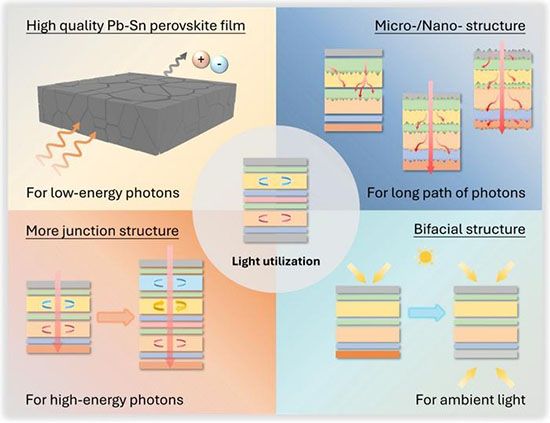 |
| The light utilization in all-perovskite tandem solar cells. (Image: Reproduced from DOI:10.1038/s41377-025-02120-5, CC BY)
|
|
The review distinguishes the optical challenges facing tandem cells from those of single-junction devices. In a single-junction perovskite cell, increasing photocurrent is relatively straightforward: reduce parasitic absorption in inactive layers and increase absorber thickness. Tandem architectures introduce at least three additional complications:
|
|
The multilayer stack and its interconnecting layer create more surfaces where photons can be reflected or absorbed unproductively. The narrow-bandgap sub-cell, which uses a lead-tin mixed perovskite, suffers from high defect density and weak absorption in the infrared range. And thin-film interference effects across the full device stack create challenges for achieving optimal current matching in the bottom sub-cell.
|
|
Lin and Tan organize light management strategies along the photon pathway into two broad categories. The first targets external optical losses, which occur before photons ever reach the perovskite absorber layers. Reflection and parasitic absorption are the primary culprits.
|
|
The total reflection profile of a tandem device varies by wavelength: ultraviolet losses stem mainly from intrinsic glass reflection, visible-range losses arise from cumulative reflection at multiple interfaces such as glass-to-ITO and perovskite-to-transport layer boundaries, and near-infrared losses compound interface reflection with inherently weak absorption by the narrow-bandgap perovskite. Parasitic absorption, meanwhile, concentrates in functional layers including the front ITO electrode, the metal recombination gold layer, PEDOT:PSS, and the back copper electrode.
|
|
The second category focuses on maximizing photon conversion once light enters the absorber. Rather than simply increasing the number of photons that arrive at the active layers, these strategies aim to improve the efficiency with which absorbed photons generate and deliver charge carriers.
|
|
The review outlines several approaches: optimizing narrow-bandgap perovskite film composition and quality to improve low-energy photon harvesting, incorporating micro- and nanostructures that extend the optical path length within the absorber, designing architectures with additional junctions to reduce thermalization losses from high-energy photons, and engineering bifacial configurations that capture ambient light from both sides of the device.
|
|
Central to the entire discussion is the principle of current matching. In a two-terminal tandem cell, the sub-cell generating less current limits the output of the entire device. The wide-bandgap sub-cell in current all-perovskite tandems already operates near its optical limit, which means that improving the narrow-bandgap sub-cell offers greater returns.
|
|
However, any optical enhancement to one sub-cell risks disrupting the current balance. Restoring a matched state typically requires co-optimization of both sub-cell bandgaps and thicknesses. As the narrow-bandgap sub-cell improves optically, the wide-bandgap sub-cell generally needs to shift toward a narrower bandgap and greater thickness to maintain balance and improve overall device efficiency.
|
|
The authors also outline future research directions, including spectral modification techniques, the development of colored tandem devices for building-integrated applications, and strategies for scaling from laboratory cells to full modules. These pathways span fundamental optical concepts, new materials, advanced device structures, and performance evaluation under realistic spectral conditions rather than idealized laboratory illumination.
|
|
All-perovskite tandem solar cells have advanced rapidly, already surpassing single-junction perovskite devices and competing tandem architectures in demonstrated efficiency. The systematic optical framework presented in this review provides researchers with a structured approach to identifying and addressing the remaining sources of photon loss. As fabrication methods continue to mature alongside these optical strategies, the technology stands positioned to make meaningful contributions to next-generation photovoltaic performance and eventual large-scale deployment.
|